
How to Grow on Snapchat: A Practical System for Qualified Audience Growth
Sustainable Snapchat growth runs on one repeating loop, not isolated tactics:
- Confirm your Public Profile is actually visible publicly.
- Give visitors one clear reason to follow.
- Assign each Snap or Story a distinct job.
- Check analytics for the weakest step in that chain.
- Fix that step before adding more content or paid reach.
Most Snapchat growth advice treats views, followers, and streaks as the same problem, but they answer different questions about your audience. The real work is finding which link in the chain — being seen by relevant people, getting them to check your profile, earning the follow, and bringing them back — is actually weak before you touch anything else. This guide walks through that diagnostic order, shows where a Public Profile fits into the path, and names the Snapchat analytics labels that tell you which part of the chain needs attention. None of it depends on buying followers, running bots, or gaming a single format; it depends on reading your own account’s evidence correctly and acting on the weakest link first.
On this page
Build a qualified Snapchat growth loop
Treat growth as a loop you run repeatedly, in this order: confirm your account and content are actually visible to the public, not just to friends; define one recurring reason your audience should care; publish content where each piece has a distinct job; create real opportunities for people to respond, rather than assuming they will; identify the earliest weak handoff using your current analytics; run a test that changes one variable at a time; and only then consider collaboration or paid reach, once your audience fit and your profile are already converting visitors. This loop is an editorial way of sequencing decisions — it is not a Snapchat-published algorithm, and no step in it is guaranteed to produce a specific outcome.
The order matters because a spike in views tells you almost nothing about the steps after it. If people are watching but not opening your profile, following, coming back, or replying, more of the same content just moves more people through a chain that is still broken further down. Before you scale a format that “worked,” check whether it actually moved the audience forward or just moved the same weak handoff to a bigger number.
Check public access before diagnosing your content
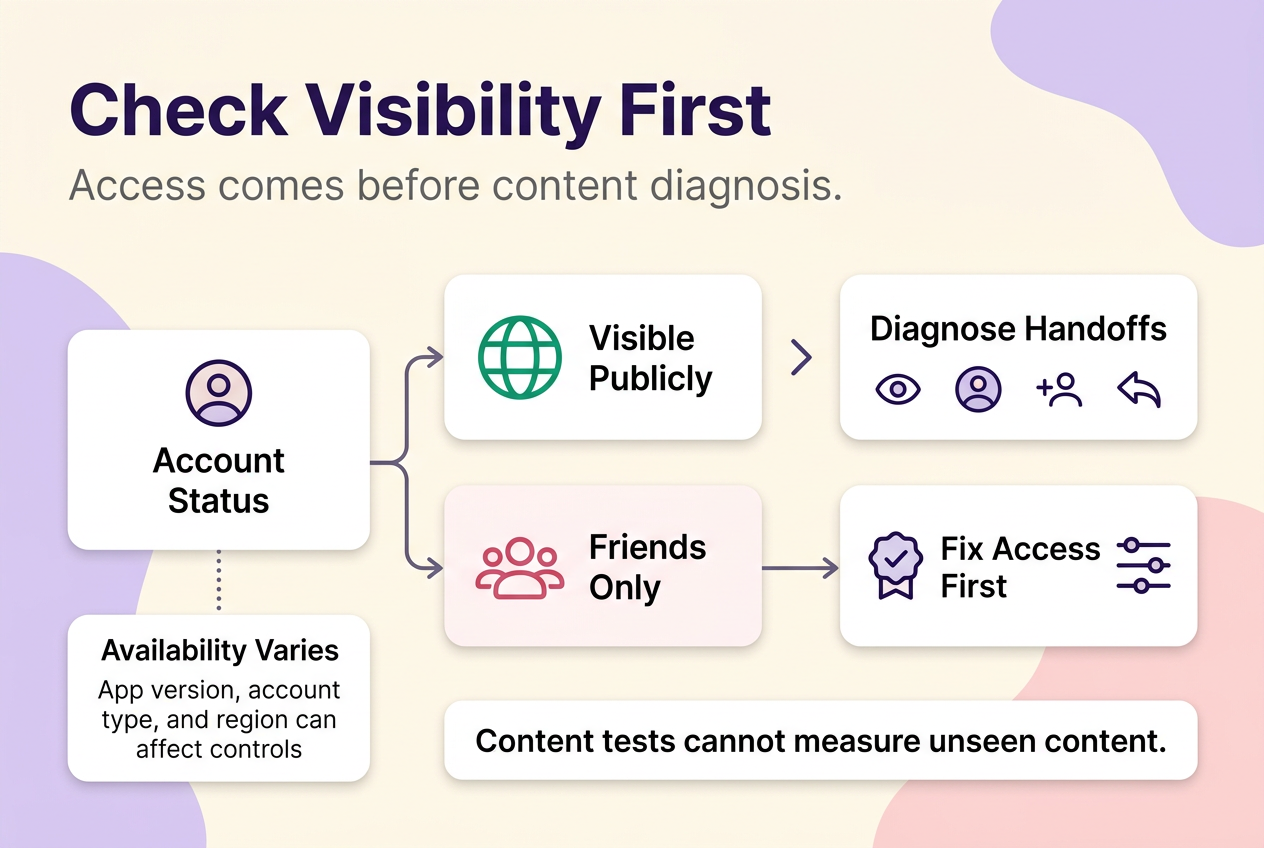
A personal Snapchat profile is visible only to friends; a Public Profile is visible to anyone on the app, and it’s optional — you choose where each Snap is shared, who can see it, and whether it’s saved to the profile at all, according to Snapchat’s Public Profile documentation. Public Profiles are built for Snapchatters ages 16 and older in certain countries, and Snapchat notes that not every account has one — that includes some accounts belonging to people under 16 and accounts that have violated Community Guidelines, per the platform’s Public Profile eligibility guidance. Indexed Snap policy materials, including Snap’s Community Guidelines, accessed August 2026, indicate that public-content surfaces use automated tools and human review and that recommended public content faces higher standards — this doesn’t describe recommendation criteria or promise exposure. None of it confirms discovery either way: it only tells you whether your account and content are visible outside your friend list in the first place. If they aren’t, no amount of content rework fixes a visibility or eligibility gap sitting underneath it. Menu names and exact availability for these controls can vary by app version, account type, and region, so confirm your current status directly in the app before changing anything else.
What sustainable Snapchat growth looks like
Views, follower counts, and other volume numbers are incomplete on their own. Sustainable growth means more of the right people discovering your account, understanding what it recurringly offers, taking the intended next action, coming back for future content, and responding when it matters — five separate outcomes, not one score. A creator building an audience will usually weight recurring viewers and follows most heavily. A small business running a Public Profile is more likely to care about local awareness, product consideration, inquiries, or actions on a linked destination. Treating a follow, a view, and an inquiry as interchangeable signals hides which outcome your account actually needs, and it’s easy to optimize the easiest number to move while the outcome that matters stays flat.
Make your Public Profile give the right viewer a reason to follow
The common mistake is building a polished, general-purpose profile that presents a broader identity than the Snap that sent someone there — a visitor arrives mid-conversation and lands on a homepage instead. A profile that continues the same conversation, rather than restarting it, needs four things: a recognizable identity that matches what the visitor just saw, one clear recurring promise about what following actually delivers, visible proof that you deliver on it, and an honest, specific reason to follow for what comes next. That is the practical core of Snapchat public profile growth — continuity, not polish. Snapchat’s Public Profile fields include a profile photo, cover photo, bio, location, and category, and you can choose whether your follower count is shown publicly at all, according to Snapchat’s profile documentation — useful space for stating the promise plainly, but the fields themselves don’t create distribution.
Fix the audience promise and profile conversion before increasing output or spending on reach. A stronger hook on a weak profile just wastes more traffic; a clear profile on modest traffic at least converts what it gets. That’s an editorial priority call about where effort pays off first, not a platform rule — but it’s the order worth defending against almost any other priority list.
Give each content idea one job
Every piece of content should have exactly one primary job: attract relevant new viewers, build trust with people who already know you, create a repeatable reason to return, invite a genuine response, or move a ready viewer toward your profile or a business destination. Trying to do all five in one Snap usually does none of them well, because the audience can’t tell what you’re asking them to do next.
Discovery-focused content can use a broad hook, but it still has to lead naturally into your recurring proposition — the thing that made someone want to see this account again. When a discovery piece and a trust-building piece look and sound identical, attention can rise while follows stay flat, because the viewer never gets a reason to distinguish “interesting Snap” from “account worth following.” If you can’t say which job a piece of content was built to do, you also can’t tell afterward whether weak performance came from the message, the format, the surface, or the profile it pointed to — you just have a number with no diagnosis attached.
Read analytics as a sequence of audience decisions
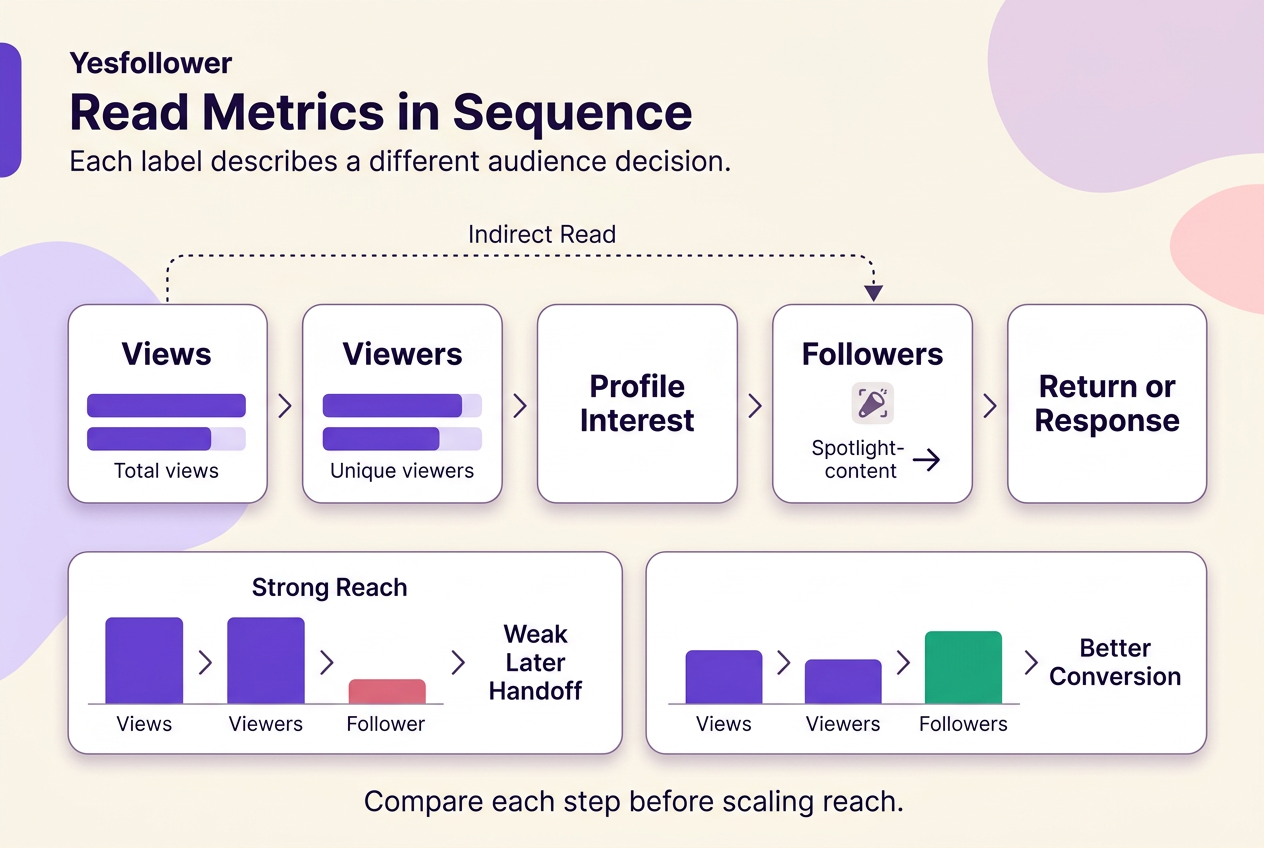
Say a home-goods creator posts a Spotlight that pulls a strong number of Views, decent unique Viewers, but almost no new Followers by the next check — an illustrative case, not a benchmark. Read that as an audience-decision failure at a specific step, not as one combined “engagement” score: the content reached people, but something between the view and the follow decision didn’t land. Indexed Snapchat Help materials, current through August 2026, distinguish Story reporting from Spotlight reporting. They describe Story views as the sum of views across individual Snaps in a Story, while Story viewers are unique viewers — a different number from the same Story, according to Snapchat’s Insights Glossary. Spotlight and Public Profile content insights list separate labels including Views, Viewers, Followers, Favorites, Reposts, Comments, Shares, Clicks, Screenshots, Average View Time, Total View Time, and Average View Rate. Indexed materials reference 7-, 28-, and 90-day ranges for certain content-insight views; available labels and filters can vary by account and app version. Followers in this context is described as new followers gained from a Spotlight — a destination signal, not an exposure signal. For accounts with more than 200 followers, an Audience Insights section also shows follower count and demographic information, per Snapchat’s Audience Insights documentation.
Treat a follower change immediately after a spike in views as an indirect, directional read on whether people who saw the content went on to act — not as a confirmed measurement of profile investigation. These are the platform’s own listed labels, and label wording can shift by app version and account type; a strong number in one of them doesn’t prove what happened at the next step.
Match the first weak signal to one next test
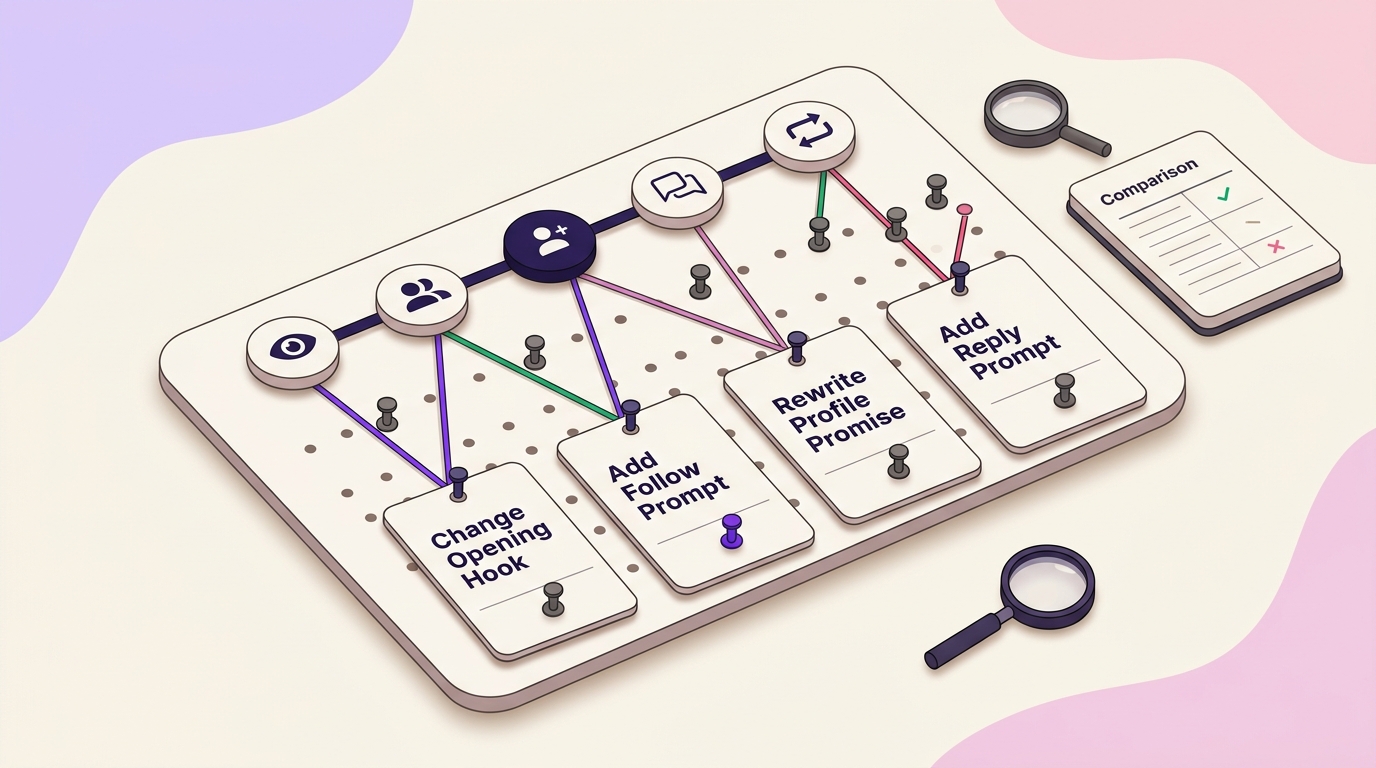
Two accounts can both show a weak follow rate for entirely different reasons — one because barely anyone with a reason to follow ever saw the content, the other because plenty of the right people saw it and still passed on the profile. Treating both cases the same way wastes the test. Work through the weakest stage first, using the table below to pick one change instead of rewriting your entire content system at once.
| Weak stage observed | Plausible explanations | Evidence to compare | One variable to test | Next signal to review |
|---|---|---|---|---|
| Low Views/Viewers on new content | Wrong audience reached; format/surface mismatch; unclear opening frame | Views and Viewers on recent comparable posts | Change only the opening hook, keep format and topic fixed | Viewers on the next comparable post |
| Viewers present, Followers flat | No signal that more exists; missing prompt; profile doesn’t continue the promise | Followers versus Viewers over the same period | Add one explicit on-Snap prompt naming what following gets someone | Followers change after the next comparable post |
| Followers remain flat across several comparable posts despite a clear follow prompt | Unclear recurring promise; no visible proof; inconsistent identity | Profile fields and recent content against the stated promise | Rewrite the bio and category around one promise, change nothing else | Followers over the next comparable period |
| Follows happen, Comments/Shares/Reposts stay low | No recurring hook; no reason to reply; content doesn’t reward return viewing | Comments, Shares, and Reposts across recent posts in the same format | Add one explicit reply prompt to a recurring format | Comments/Shares/Reposts on the next post in that format |
Choose a publishing rhythm you can actually learn from
Universal posting schedules aren’t the answer here — chasing an unverified “best time” or frequency just adds a variable you can’t control for, and it substitutes someone else’s account for the evidence in your own. Pick a publishing pace you can sustain without dropping production quality, repeat a small set of content propositions instead of a new idea every time, and use trends, sounds, or filters only when they reinforce your existing promise rather than replacing it. Compare timing and frequency against your own account’s past comparable performance, not a generic rule someone else’s account produced.
Posting more often can actually make results harder to read: if topic, hook, format, timing, and profile messaging all change from post to post, a weak week tells you nothing about which of those five things caused it. Fewer, more repeatable formats give you cleaner comparisons and leave enough capacity to actually review what happened before you post again.
Collaborate for audience fit, not borrowed vanity metrics
Choose collaboration and cross-promotion based on audience overlap, a genuinely useful shared idea, a clear contribution from each side, and a comparison of qualified actions after the collaboration against similar non-collaboration content — not on follower count alone. A smaller partner whose audience actually needs what you make is frequently more useful than a bigger, broader account, because broad exposure without context tends to inflate views without moving anyone through the rest of the loop.
If a collaboration involves payment or free product in exchange for promotion, current U.S. guidance calls for a disclosure that’s hard to miss and placed with the endorsement itself, according to the FTC’s disclosure guidance for social media — a platform label alone doesn’t automatically satisfy that obligation. Skip anything that resembles automated outreach, comment pods, or follower swaps to manufacture the appearance of fit; it produces numbers you can’t trust when you’re deciding what to test next.
Use paid amplification only when it has a defined job
The distinction that matters is readiness, not budget: a paid test earns its place once the objective is explicit, the intended audience is defined, your Public Profile or landing destination is actually ready to convert a visitor, organic results have already informed the creative you’re testing, and you’ve set a review point where you’ll measure and decide to stop or continue. Your strongest organic post is not automatically the right paid asset, because a campaign objective and destination determine which evidence is relevant — a post that earned Views and Comments isn’t proven to convert cold traffic toward whatever action the campaign is built for.
Snap maintains advertising documentation covering how to launch, manage, and troubleshoot campaigns, according to Snap’s advertising policies. Confirm the currently offered product, its eligibility, approval process, and reporting directly in Snapchat’s business documentation before committing any budget, rather than assuming paid reach behaves like an extension of organic performance.
Avoid shortcuts that distort growth signals
Avoid tactics that create misleading signals: purchased followers or engagement, bots, follow/unfollow cycles, unsolicited automated outreach, auto-commenting, and engagement-pod manipulation corrupt the very data this loop depends on. Separately, Snap’s Terms of Service prohibit automated or semi-automated access — including robots, scrapers, and scripts — and unauthorized third-party applications interacting with the service or your content without permission. That’s distinct from the native controls Snapchat documents for editing, clearing, or deleting your own Public Profile; using those doesn’t put you anywhere near what the Terms restrict. Rely on relevant content, audience-fit collaboration, and real manual interaction instead.
Choose one first Snapchat growth action
Pick one branch based on where you actually stand. If your audience promise is unclear or your profile reads as generic, revise the Public Profile around one recurring value before doing anything else. If the promise is already clear, select one recent piece of content, identify its earliest weak handoff using the comparable analytics covered above, and run one test that changes a single variable before you add more output or spend on reach. The goal of this first action is a decision-producing observation, not a full overhaul — change one thing, keep the rest constant, and you’ll actually know what moved the number when you check again.
For broader context on building out a Snapchat presence beyond this growth loop, see the Snapchat resource hub.
No method guarantees a specific number of followers or views.
 120,000+ creators say yes
 Real Active Accounts


 Username Generator
  Hashtag Generator
  Font Generator