
How to Get More Followers on LinkedIn: An Organic Growth System
Getting more followers on LinkedIn depends on five things working in sequence, not a single trick:
- Make your profile clearly followable by a defined audience
- Define who you want to attract and what you’ll post about
- Give every post one clear job for the reader
- Take part in real conversations, not automation or bots
- Review who follows, not just who views, before changing tactics
A slow follower count rarely gets fixed by posting more often, jumping into more comment threads, or testing a new format every week. The sequence that actually matters is profile clarity, then audience and topic continuity, then post design, then participation — with diagnosing weak post views coming after all of that, as a downstream symptom rather than the starting point. None of it depends on buying followers, automating engagement, or a fixed timeline; it depends on comparing your own posts against each other and changing one variable at a time.
On this page
How to get more followers on LinkedIn
Building a relevant LinkedIn following works best as five steps done in order, not five options to pick from. Skipping ahead to posting volume before the first two steps is the most common way this goes wrong.
- Fix profile conversion first. State plainly who you help, the problem or outcome you’re known for, and what a visitor gets by following rather than just viewing.
- Set an audience hypothesis. Name the role, problem, context, and outcome of the person you want reading your posts, and pick a content territory recognizable enough that a repeat visitor knows what to expect.
- Design each post around one job. Decide whether a post teaches, argues a point, proves credibility, invites a specific response, or announces something — before choosing a format.
- Earn discovery through real participation. Comment with substance on relevant posts and build actual professional relationships instead of running automated outreach.
- Review the full signal chain before changing anything. Look at exposure, response to the specific ask, profile visits, follows, and whether the people who followed match the audience you defined, then make one change.
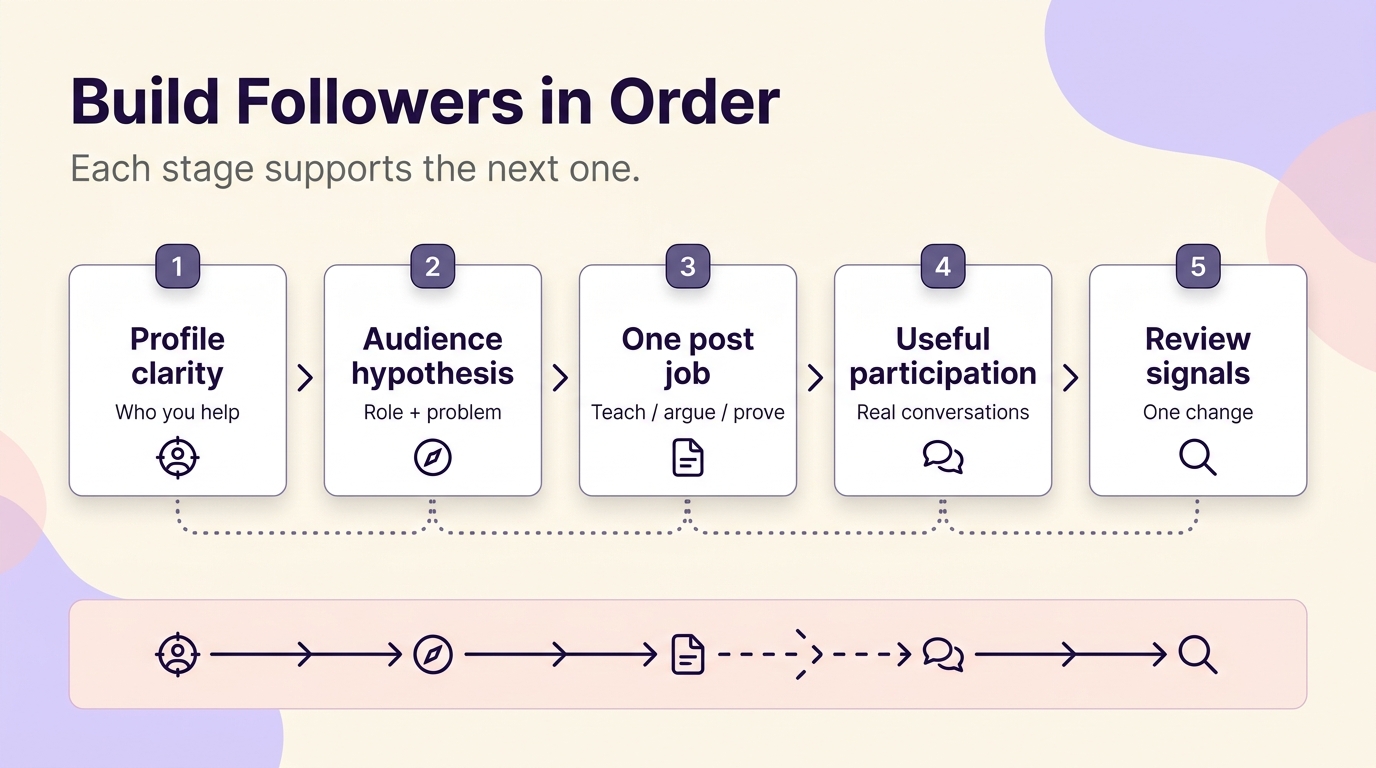
A profile visit is not the same as follower intent. A visitor who lands on your profile from a useful post can still leave without following if the profile reads like it serves a different audience or topic than the post did — which is exactly why step one comes before step three, not after it. Skipping straight to volume or format experiments can raise activity and even raise a follower total without building an audience of people who are actually clients, peers, buyers, partners, or hiring managers. This sequence is an editorial way of organizing that work, not a documented LinkedIn ranking formula, and following it doesn’t guarantee a specific number of new followers.
Followers, connections, and the audience quality that matters
Growing a relevant audience matters more than growing whichever total is largest, because followers, connections, and newsletter subscribers are three separate relationships with separate visibility rules. LinkedIn documents that connection lists and shared connections are visible to your first-degree connections and to people who share connections with you, unless that visibility is restricted — a privacy setting, not a growth mechanism. Post visibility works separately from either relationship: a post set to “Connections only” reaches only first-degree connections, while a post set to “Anyone” is visible more broadly, on or off LinkedIn.
Newsletter subscribers are a further, distinct relationship. LinkedIn documents that members can subscribe through a newsletter page’s Subscribe button or by accepting an invitation from a connection or someone they follow — but subscribing doesn’t mean a connection or follower automatically becomes a subscriber, or the reverse. The number worth tracking isn’t whichever total happens to be largest; it’s whichever relationship actually contains the people your work is for.
Start with profile conversion, not more posting volume
Posting more often won’t fix a profile that fails the ten-second test, and this is where I’d put the priority before anything else on this list. A generic title like “Consultant” or “Marketing Leader” can be accurate and still lose a visitor if that person can’t tell who you help and what following gets them without opening the About section, the Featured section, and a handful of recent posts to piece it together.
Two settings are worth checking directly. As of August 31, 2026, LinkedIn documents a follow and profile-action setting that lets a member choose whether people beyond their connections can follow them at all, and separately lets a member display “Follow” instead of “Connect” as the primary action on their profile. Neither setting is documented to change reach or ranking — they change whether following is even available and how visible that option is to a new visitor. Confirm current wording and availability against LinkedIn’s own settings before relying on this description.
The failure mode to watch for: more posts driving more profile visits while the follow rate on those visits stays flat, because the profile and the post are quietly serving two different audiences.
Choose an audience hypothesis and a recognizable content territory
Define one audience by role, the problem they have, the context they’re in, and the outcome they want — then build a content territory around the questions that audience actually asks, a consistent point of view, and evidence a reader can check. A recognizable territory doesn’t mean repeating one format or one post structure; the same recurring problem can be approached through a data breakdown, a client-facing lesson, or a direct opinion without making the profile feel scattered, as long as the underlying question stays consistent.
Where this goes wrong is topic drift disguised as variety: a week of hiring commentary, a week of personal reflection, a week of industry news reaction. Each post might perform fine on its own while attracting a different set of people every time, none of whom have a reason to stick around, refer work, buy, partner, or remember you for the next relevant conversation.
Give each post one useful job
The most common post-quality mistake is stacking a lesson, a personal story, a promotion, and two or three questions into one short post. Every element might be individually reasonable, but the reader can’t tell what they’re supposed to do with it, and neither can LinkedIn’s own analytics tell you which part of the post the response was actually about.
Pick one job before writing: teach something specific, make an argument, demonstrate credible proof, ask for a particular kind of response, or announce something relevant to your stated audience. Then choose the format because it serves that job. LinkedIn documents individual post analytics for text posts, images, videos, events, polls, and articles, along with support for document posts within a feed update — none of these formats is established as a universal reach winner, and choosing one because it’s “supposed to perform better” this quarter tends to produce content that serves the format instead of the reader.
Earn discovery through useful participation and relevant relationships
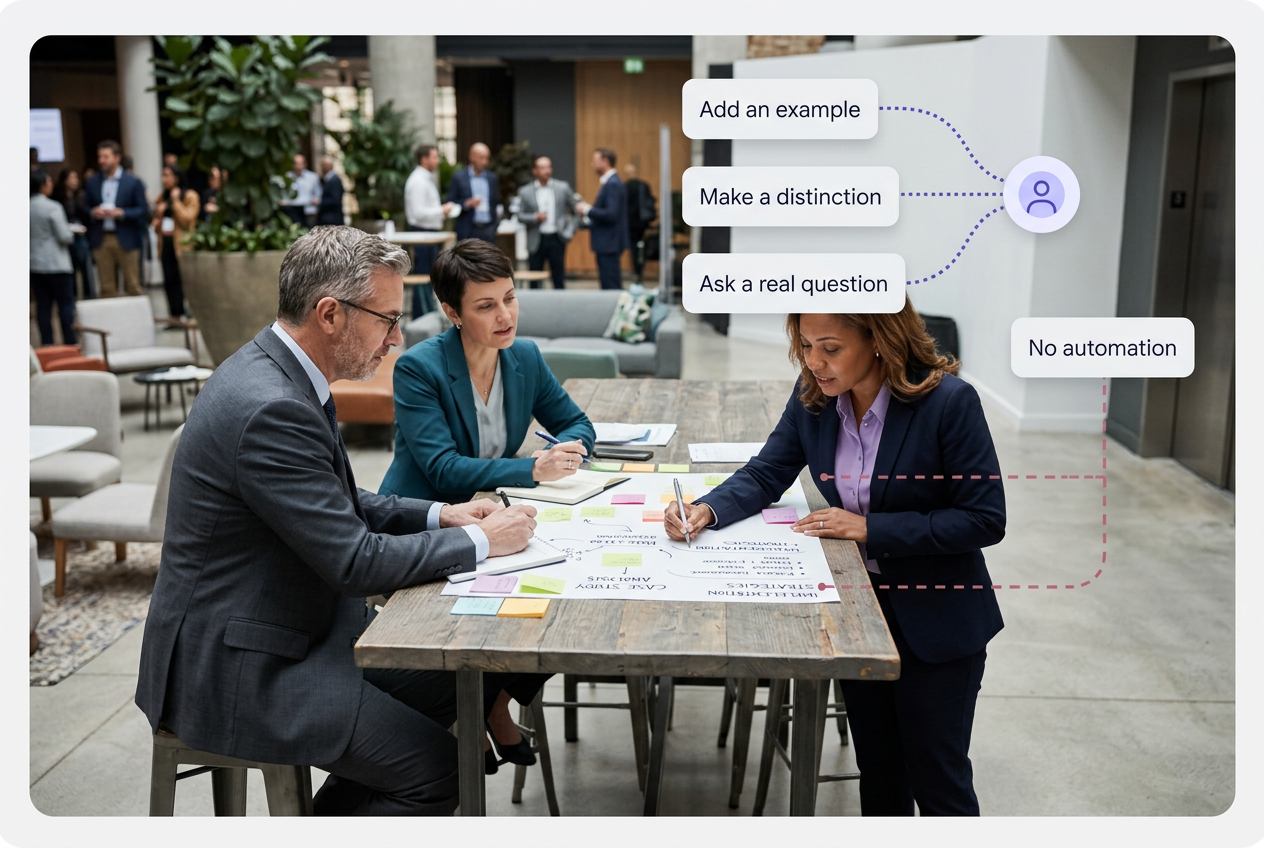
A comment that repeats the original post’s conclusion, or a comment that pivots to unrelated self-promotion, creates visibility without creating relevance — and it’s a mistake worth naming directly, because it’s the most common substitute for real participation. A comment that adds an example, a distinction the post missed, a genuine question, or a practical implication does the opposite: it gives the original author’s audience a reason to check who wrote it.
Build actual professional relationships and collaborate only where there’s a real shared audience or topic, not a vague mutual-promotion arrangement. Keep this distinct from paid distribution, which is a different tool with a different measurement plan: in Campaign Manager, an objective is the goal set for an ad, and ad sets are optimized to deliver to people likely to take the action tied to that objective — a mechanism that has nothing to do with organic comment activity or profile visits, and shouldn’t be treated as an equivalent substitute for either.
When LinkedIn post views are low, find the weak link before changing tactics
Increasing LinkedIn post views without guessing at the cause means checking which of three states you’re actually in before changing anything: low exposure, views without a meaningful response, or a meaningful response that still isn’t turning into follows. Each state points to a different fix, and copying whatever format got the most views last time can miss the actual bottleneck.
As of August 31, 2026, LinkedIn defines impressions as the number of times a post was shown on LinkedIn — the metric most people mean when they say “views.” That documentation doesn’t provide a unique-member definition, so treat impressions as a display count, not a count of distinct people.
| Observed state | What to review | Next change |
|---|---|---|
| Low impressions | Post visibility setting (Anyone vs. Connections only) and whether the topic matches an audience likely to engage with or reshare it | Fix visibility or audience relevance before testing anything else |
| Views with a weak meaningful response | Whether the post was specific enough, backed by evidence, or ended with a prompt worth responding to | Rewrite for specificity and a sharper ask, not a new format |
| Meaningful response without follows | Whether the profile promises the same audience and topic the post just delivered | Fix profile continuity before publishing more of the same post |
Low impressions alone don’t establish an account restriction. Compare the post against your own comparable posts before changing more than one variable.
Use one signal chain to improve the next cycle
Impressions, the response tied to your post’s specific ask, profile visits, follows, and whether those new followers match your intended audience each answer a different question — treating any one of them as a stand-in for the others is the fastest way to draw the wrong conclusion from a normal week. Compare posts that are actually comparable, since averaging a teaching post together with a launch announcement produces a number that doesn’t describe either one, and change one material variable per cycle rather than adjusting topic, format, timing, and profile all at once.
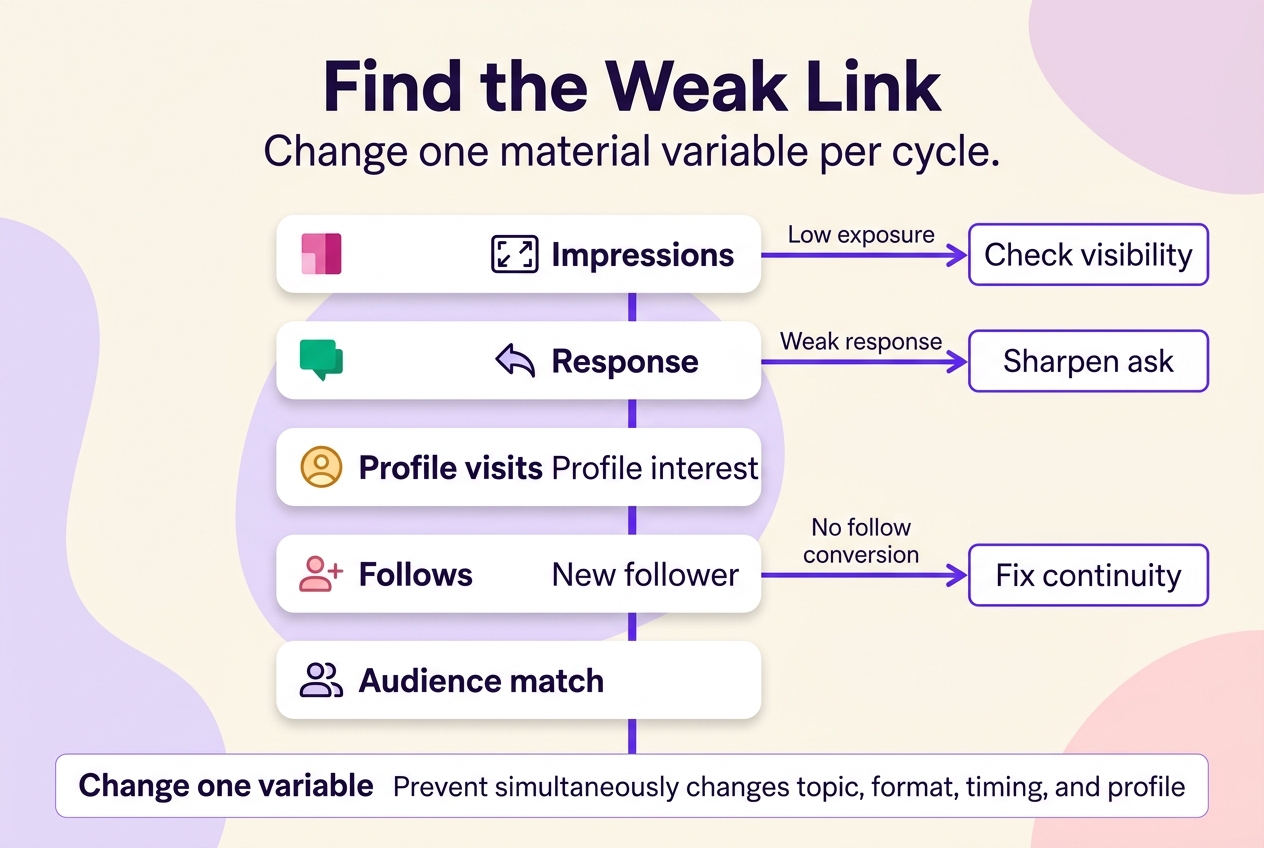
If your account currently reports profile visits and follows at the post level, one useful calculation is a visit-to-follow rate: follows divided by profile visits, expressed as a percentage. That’s illustrative arithmetic, not a benchmark to match — a low rate on one post only tells you where a visit stopped becoming a follow on that post, and you’d still need to check the profile and the post’s audience fit directly to know why.
Build a sustainable publishing and review loop
Set a publishing cadence your production capacity can actually sustain, then test timing only against your own account’s comparable-post history — there’s no universal best day, hour, or post count that applies across accounts, industries, and audiences. Keep the post’s job reasonably stable while you test timing, because changing timing, topic, format, and call to action together in the same week makes it impossible to learn anything specific about timing at all.
As of August 31, 2026, LinkedIn documents native scheduling for a specified date and time — enough to hold a steady rhythm without needing a third-party tool, though no performance advantage from scheduling is documented. Generic “best time to post” advice, applied without checking it against your own comparable posts, tends to produce lower-quality content chasing a slot instead of a reader.
Skip artificial follower-growth tactics
Don’t buy followers or engagement, use bots, run follow/unfollow cycles, auto-comment, join engagement pods, share credentials, or send unsolicited mass outreach. LinkedIn’s User Agreement prohibits scraping and bots or other unauthorized automated methods used to add or download contacts, send messages, or create, like, comment on, or share content to drive inauthentic engagement. Keep outreach relevant and non-repetitive under LinkedIn’s Professional Community Policies, which prohibit spam — untargeted, irrelevant, unwanted, or gratuitously repetitive messages and content. Put that effort into profile relevance, useful posts, and genuine participation instead, and if you want distribution beyond your organic reach, use a defined paid campaign with its own objective and its own measurement plan rather than an organic-looking substitute.
An artificially inflated total corrupts the one thing you’re actually trying to learn: whether real, relevant people respond, visit, and follow. Scraping and unauthorized automation are documented platform violations; follow/unfollow cycles, engagement pods, and credential sharing sit outside what this guide treats as legitimate growth even where they aren’t named individually in that policy language.
Choose the first bottleneck to fix
If profile visits aren’t turning into follows, fix the profile. If views aren’t producing a meaningful response, fix the post’s usefulness or audience match. If publishing and review are inconsistent, start the sustainable loop before anything else. If you have a specific campaign goal, audience, and budget, paid distribution belongs there — not as a stand-in for the steps above. Pick the smallest change that addresses the clearest bottleneck; changing the profile and the content strategy at once removes your ability to tell which one actually worked, and that’s how you grow LinkedIn followers deliberately instead of by accident. For related settings and formats, see the LinkedIn growth hub.
No method guarantees a specific number of followers, views, or income.
 120,000+ creators say yes
 Real Active Accounts


 Username Generator
  Hashtag Generator
  Font Generator