
How to Grow on Threads: A Practical Audience and Value System
Growing on Threads follows a short sequence, not simply posting more often:
- Pick one measurable goal and its next action
- Make your profile and purpose obvious to a first-time visitor
- Publish audience-specific posts and add replies that contribute real value
- Invite an existing audience on another channel into the conversation
- Test one variable at a time on a cadence you can sustain
- Keep only the activity that still moves your chosen goal
Most Threads growth advice collapses into one instruction: post more. That ignores the fact that views, replies, follows, traffic and revenue are different outcomes that respond to different actions, so treating them as interchangeable makes it impossible to tell whether an approach is actually working. This guide sets out an ordered system for building a Threads audience — choosing a goal, fixing the profile, publishing and participating with intent, testing one variable at a time, and reading what the platform’s own recommendation surfaces will and will not tell you. It closes with how to connect that activity to measurable business value, including how to weigh a paid or sponsored relationship on Threads by cost, risk and compliance rather than assuming a platform label settles every legal question on its own.
On this page
How to grow on Threads without chasing volume
Growing a Threads audience productively means working through seven actions in a fixed order, each one requiring a different decision, asset or check rather than just more output. Publishing volume without deciding what “growth” is supposed to produce is the single most common way this goes wrong.
- Choose one outcome and one next action for the current reporting period.
- Make the profile and its destination unmistakable to a new visitor.
- Publish original, audience-specific ideas instead of generic commentary.
- Add manual replies that contribute something new to conversations you don’t own.
- Invite an existing audience from another channel into a Threads discussion.
- Test a cadence you can sustain without a drop in quality.
- Keep only the activity that still serves the outcome you picked, and drop the rest.
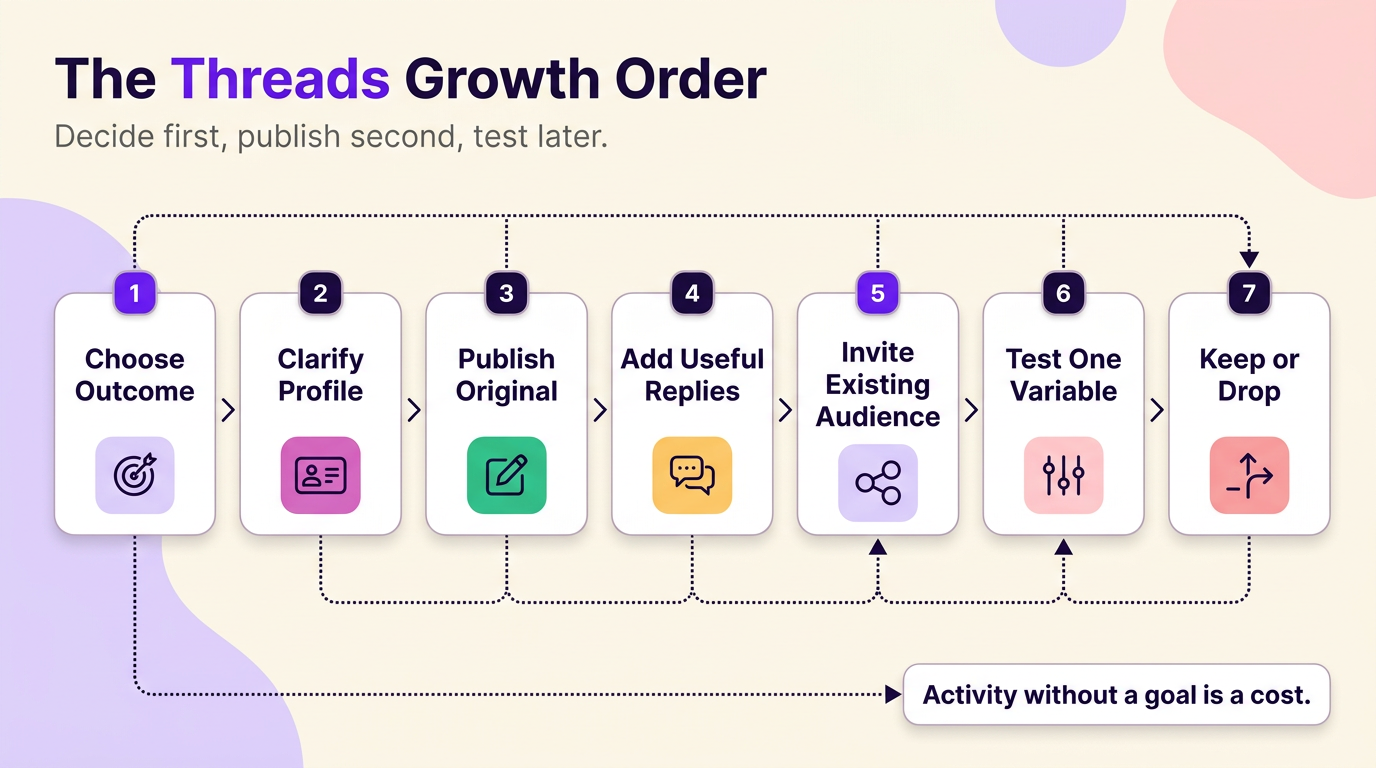
The order matters more than any single step. Outcome selection comes first because everything downstream — what you publish, how you reply, whether you cross-promote — is judged against it; skipping to step three means producing content nobody can later evaluate against a real business question. Cadence testing sits near the end deliberately: there is no defensible universal posting frequency to start from, so a sustainable pattern only becomes visible once you know what a post is supposed to do. The last step is the one most accounts skip. A content lane, a reply habit or a cross-posting routine that isn’t advancing the chosen outcome is a cost, not neutral activity, and retiring it is as much a growth decision as adding something new.
Choose the outcome before you choose the content
Growth on Threads is not one outcome; it’s at least eight — awareness, a profile action, a follow, a website action, a lead, a sale, retention, or a creator-income opportunity — and each needs its own next action and its own measure for a defined period. Reach, engagement actions, follows, traffic and revenue must stay as separate figures rather than being folded into a single “growth” number.
An audience-research post is a useful example of why this separation matters. A post that simply asks a question to surface language and objections can be valuable even if it never sends anyone anywhere — judging it against a traffic or sales goal it was never built for will make it look like a failure it isn’t. Before publishing, write down which of the eight outcomes a piece of content serves and what a person does next if it works; that pairing is what later performance review checks against.
Make the profile useful when a new person lands on it
A visitor who reaches your Threads profile from a reply or a repost, rather than a homepage or a series, needs to understand three things immediately: who the account helps, why it posts, and what to do next. That means the profile description and the posts a stranger sees first have to work on their own, without assuming any prior context.
This is where accounts lose people quietly. Someone reads one sharp reply, taps through, finds a profile with no clear point of view and no obvious next step, and leaves without following or visiting anywhere. Write the description as if the reader has seen exactly one thing you’ve written, because for a large share of visitors, they have. Whatever destination you point people toward — a link, another profile, a specific post — should match the reason they clicked through in the first place, not a generic homepage that requires them to re-orient.
Threads algorithm explained: focus on what you can verify
The Threads algorithm is not something a creator can inspect or reverse-engineer, and treating an outside claim about how it weighs individual signals as fact is a mistake, however confidently it’s stated. What is actionable is narrower: the settings you control directly, the distribution and sharing surfaces you can see in the app, the metrics Threads defines for you, and any status, eligibility or enforcement notice Threads actually shows your account. Everything else is inference dressed up as insight.
There’s no published source that maps exactly how format, timing or wording changes recommendation odds, so treat comparable results on your own account — same format, similar topic, adjacent time window — as your working test rather than adopting rules written for someone else’s audience.
Check documented restrictions and access settings before changing strategy
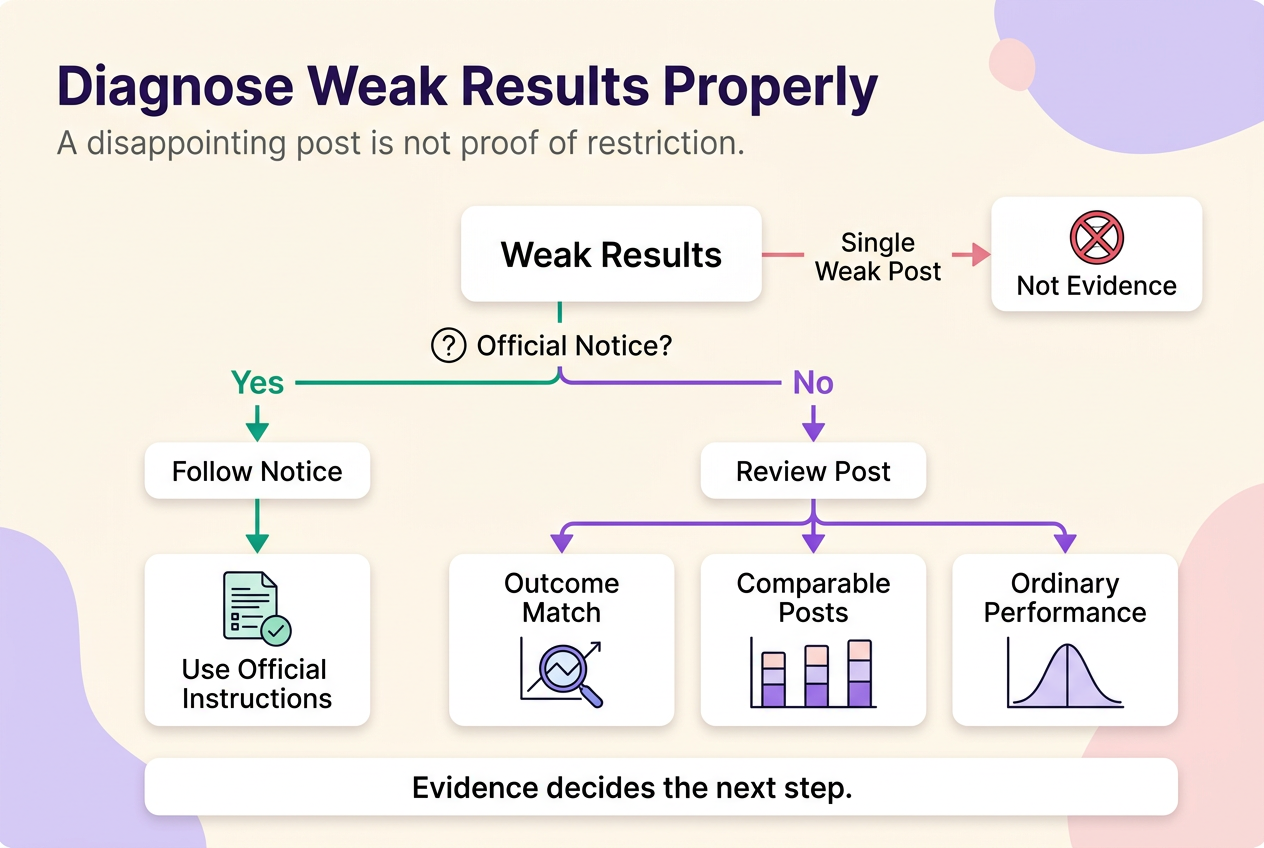
A single underperforming post is not evidence of a distribution restriction. Where Threads or Meta shows you a documented account or content status, an enforcement notice, or an eligibility message, follow the instructions that notice actually gives you rather than guessing at a fix — treat it as the authoritative next step, not a cue to overhaul your whole content strategy. Where no such notice exists, weak results call for ordinary performance review: check whether the post matched an outcome you were actually testing, not an assumed penalty nobody flagged. Confusing the two wastes effort in opposite directions — chasing a ranking fix for a policy issue, or overhauling a strategy that was really just an off-topic post.
Make posts and replies worth encountering
A Threads presence earns a follow when it gives people a specific, repeatable reason to keep checking in. That means running a small set of content lanes rather than posting whatever is top of mind: answering a question your audience actually asks, showing proof or process instead of claims, prompting a discussion informed people want to weigh in on, or deliberately gathering audience language and needs. Replies deserve the same standard. A generic compliment or a self-promotional line adds nothing to the conversation and gives a reader no reason to visit your profile; a reply that adds context, evidence, a sharper question, or a clear point of view can stand on its own even without a follow-up.
Give each content lane one job
Consider a freelance graphic designer’s Threads account that posts one question a week asking followers what part of pricing confuses them most. Views on these posts often run lower than a strong opinion post, but the account logs recurring themes in the replies rather than judging the post by its view count. If, in an illustrative case, forty replies surface the same three pricing questions, that’s a concrete brief for a future post or a paid guide — the post did its job even though it wasn’t the week’s top performer by views. Without a declared job per lane, every post gets judged by the same yardstick, and research-led content will always look weak next to opinion content it was never competing with.
Participation must remain useful, selective, and human-controlled
The fastest reply often carries the highest reputational cost when nobody owns voice, approval or escalation for sensitive conversations. Meta’s documented Threads API supports approved third-party tools that publish posts, publish replies, and retrieve insights on a creator or brand’s behalf — useful for scheduling and reporting at scale. As of August 2026, the opened API materials do not document endpoints for automated likes or follows, so assess any engagement-automation vendor separately rather than treating it as a documented Threads capability. Keep a person accountable for tone and for deciding when a reply needs escalation rather than an instant response.
Use cross-promotion as an invitation, not a copy-and-paste tactic
Posting identical copy across every channel wastes production effort and asks an audience to do the work of translating why they should care on a new platform. Cross-promotion works better as an invitation: give an existing audience on another channel a specific reason to continue a conversation on Threads, then adapt the idea rather than duplicate the post.
Meta’s Accounts Center lets people start or stop sharing selected Facebook or Instagram posts and stories across connected profiles, including Threads; sharing Instagram content to Threads specifically requires the Threads account to use the same username as the connected Instagram account. That is a distribution convenience, not a documented growth or recommendation lever — it moves a post across profiles you already control, and it does not transfer followers or improve how Threads recommends anything. When you do share across profiles, add a line specific to the Threads audience so the post reads as a reason to join the discussion, not a repost.
Cadence is a capacity decision, not a universal rule
There is no defensible universal posting frequency or best time to post on Threads. What works instead is a baseline you can sustain without a drop in quality, tested one variable at a time.
Set a starting cadence based on the time you actually have, not an aspirational number. Then change one thing per test window — topic, format, timing, or call to action, not all four together — and compare results against posts that are otherwise similar. Changing several variables at once produces a result you cannot attribute to anything specific, which defeats the purpose of testing at all. Increase cadence only when a higher frequency measurably improves the outcome you chose in the first section, and roll it back the moment quality or response time starts slipping; a generic quota that ignores your actual capacity tends to produce burnout and weaker posts long before it produces an audience.
Measure Threads from attention to qualified business value
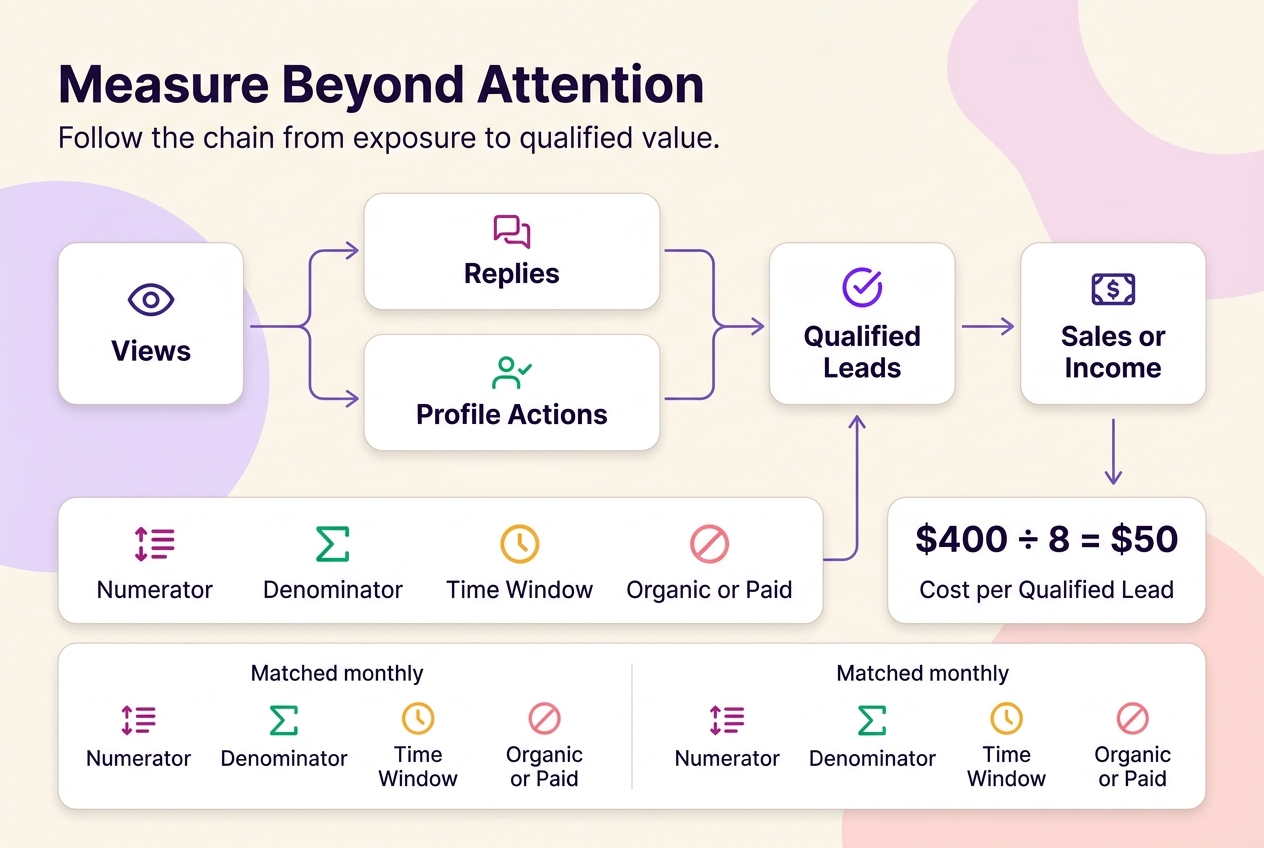
Threads Insights reports post-level metrics including views, replies, reposts and quotes, and the Insights API lets an authorized account query those figures over a chosen window using a required metric parameter and optional start and end dates, as documented in Meta’s Threads Insights API reference. None of that, by itself, tells you whether the attention converted into anything a business can use — that requires building a chain from exposure and interaction through to profile actions, qualified site actions, leads, sales, retention or a creator-income opportunity, and comparing the cost of producing that activity against what it actually returned.
Whenever you calculate a rate from these figures, state the numerator, the denominator, the time window and whether the scope is organic, paid or both in the same sentence as the number — a percentage with no denominator is not a usable figure. Cost per qualified action follows the same logic: divide total attributable channel cost by the number of qualified actions in the same period. As an illustrative example only, if a month of Threads activity costs $400 in labor and tools and produces 8 qualified leads in that period, cost per qualified lead is $400 ÷ 8 = $50. That figure says nothing about whether $50 is efficient for any particular business — it only gives a comparable number to track against other channels or future months, using the same definitions each time.
When Threads supports income, choose the path by cost, risk, and evidence
Threads can support several distinct commercial paths, and they carry different requirements, costs and risks rather than being one generic “monetization” question. Comparing them by mechanism, staffing and economics — not by follower count — is what makes the choice defensible.
| Path | Mechanism | Audience action required | Operating requirement | Primary risk | Leading metric | Business metric |
|---|---|---|---|---|---|---|
| Sponsored or paid partnership content | A brand pays for a post, series, or mention | Attention and trust in your voice | A point of contact for brand outreach and a rate or offer prepared in advance | Reputational cost if the partnership fits the audience poorly | Qualified brand inquiries per period | Revenue per sponsored post, net of production cost |
| Affiliate or referral links | Commission on a tracked action taken after a link | Click-through and follow-through on a specific offer | A trackable or tagged link and a place to log conversions | Weak attribution without a tagged or trackable link | Tracked clicks per link, by period | Commission earned per period, net of time spent |
| Lead generation for your own services | Posts and replies route interested people to a contact or booking step | Enough trust to take a specific next step off-platform | A defined next step — form, booking link, DM — and someone to follow up | Weak qualification if the “next step” isn’t specific | Qualified leads per period | Booked or closed engagements per period |
| Direct product or service sales | Posts and replies move people toward a purchase | Enough proof or trust to convert intent into a transaction | A working purchase path and the capacity to fulfill demand | Mistaking reach for revenue | Attributed sales per period, net of cost | Revenue per period, net of production and platform cost |
| Audience research and retention | Discussion surfaces language, objections and demand for other channels or offers | Willingness to answer questions or react to prompts | Time to log and review replies, not ad spend | Treating a handful of replies as validated demand | Recurring themes logged per period, not follower count | Influence on content or offer decisions in the following period |
Compensation, affiliate commissions and paid partnerships can carry disclosure obligations under US advertising law that exist independently of any platform label or tool. Confirm the current requirement that applies to your specific arrangement — through current FTC guidance or qualified legal counsel — before publishing, rather than relying on this table alone.
Your first week: establish a baseline before drawing conclusions
Use the first reporting week to build a working rhythm, not to judge the channel. Choose one outcome from the list above and record a baseline for it. Review any current official account notices or settings that apply to your account, and address them before interpreting results. Draft a short list of audience-specific post and reply prompts tied to your content lanes. Publish and participate manually rather than through unverified automation. Log results in comparable terms — same metric, same period, same organic-or-paid scope — and pick exactly one variable to test in week two.
A first week is a starting point, not a verdict. It gives you the baseline the next test compares against — not proof that a content lane, a cadence, or a cross-promotion habit works or fails.
For a broader view of how Threads fits alongside the rest of your social strategy, see the Threads section hub.
No method guarantees a specific number of followers, views, or income. Results depend on niche, content quality, and account history.
 120,000+ creators say yes
 Real Active Accounts


 Username Generator
  Hashtag Generator
  Font Generator