How to Grow a Facebook Page Fast: An Ethical, Measurable Process
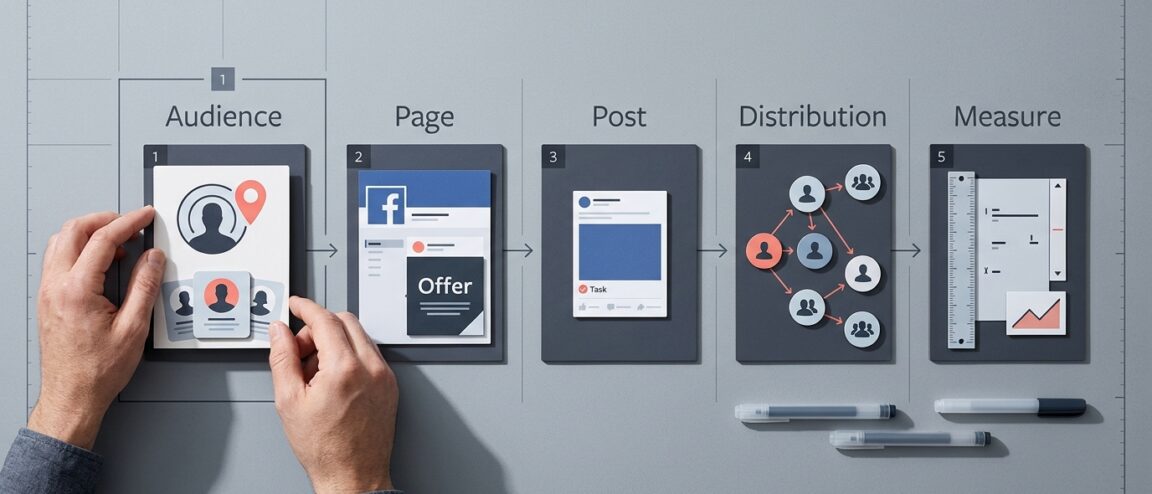
Growing a Facebook Page fast means fixing the right bottleneck first, in this order:
- Define the exact audience and its useful next action
- Make the Page’s identity and purpose clear
- Give every post one measurable job
- Share posts where people already have a reason to care
- Compare native results before considering paid delivery
Most Facebook Pages that grow slowly aren’t short on content; they’re short on a clear reason for someone to follow. Speed here means diagnosing which part of that system is actually broken — the audience definition, the Page itself, the post, the distribution, or the measurement — rather than assuming more posts will fix it. This guide walks through that diagnostic order, names the native Facebook controls that support growing a Facebook Page organically, and separates documented policy from ordinary judgment. It does not promise a follower count or a timeline, because no method can guarantee either.
Grow a Facebook Page faster by fixing the right bottleneck first
“Fast” growth on Facebook is really fast diagnosis: finding which stage of the growth system is holding back results and fixing that stage before adding more content or spend. The order below moves from the most foundational decision to the most conditional one.
- Define the audience and the action you want from them. Name a specific group, the problem they have when they land on the Page, and what a new follower is actually for — a future customer, a return visitor, a lead. A vague audience produces vague content decisions.
- Make the Page itself a credible destination. Before publishing more, check what a first-time visitor actually sees: whether the Page’s purpose, offer, and next step are legible in a few seconds.
- Give each post one job and compare like with like. Decide whether a post exists to get discovered, teach something, prove credibility, start a conversation, or drive a business action, then only compare it against posts doing the same job.
- Distribute through channels where attention is already earned. Existing customers, collaborators, subscribers, and communities that allow the contribution are more reliable than hoping the Page’s own reach carries a new post.
- Convert engagement through native tools, then measure before repeating. Use the features Facebook actually provides for turning interaction into follows, check whether the numbers moved for the right reason, and only then weigh paid delivery.
More posting volume or wider exposure cannot repair an audience definition that’s too broad, a Page that doesn’t explain itself, or a distribution channel with no reason to care. Working the list in this order means each later step is worth doing — spending on distribution before the Page converts visitors mostly buys traffic that arrives and leaves. “Fast” here means shorter diagnosis-and-iteration cycles, not a guaranteed follower count or a fixed timeline.
Which of these five is worth fixing first depends on where a Page actually gets stuck: an unclear audience, a Page visitors don’t trust, content with no defined job, distribution nobody asked for, or measurement that can’t tell you which of the other four to fix. The sections below work through each in turn.
Check published Page conditions before diagnosing a growth problem
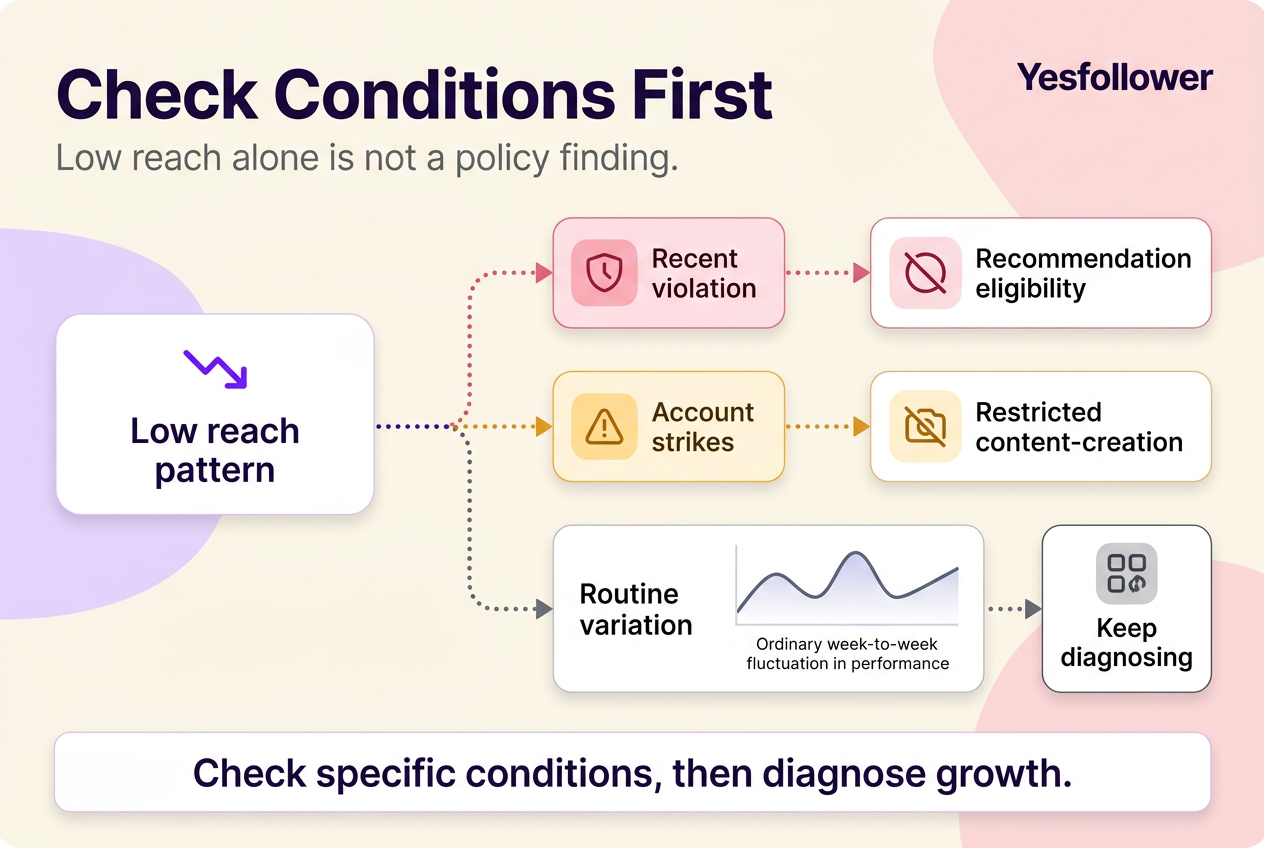
Before assuming a content or distribution problem, rule out documented conditions that affect whether Facebook will show a Page to new people at all. A single underperforming post is not evidence of a policy or eligibility issue — but a pattern of low reach alongside a recent violation or account restriction is worth checking first.
Facebook states it generally does not recommend Pages that have recently violated Community Standards, repeatedly used misleading follower-building practices such as buying likes, or repeatedly shared content it tries not to recommend. Recommendation eligibility is a separate, higher bar than simply being allowed on the platform. Separately, Meta’s strike system can restrict the Facebook account behind a Page — not the Page itself — from creating content: most violations reaching seven strikes trigger a one-day restriction on posting, commenting, and creating a Page, with longer restrictions following higher counts. Neither condition explains routine week-to-week variation in an existing Page’s reach, so check for these specifically rather than treating them as a default explanation.
Start with the audience worth growing
“Grow the Page” is not specific enough to guide a single content or distribution decision, and that’s usually where the standard advice — post more, post video, post daily — breaks down. It treats every new follower as equally useful, when most Pages actually need one specific kind of person to show up more often.
A workable audience definition names three things: the situation someone is in when they’d plausibly find the Page, the problem they have in that moment, and the action that would make a new follow worth having — a future customer, a repeat visitor, someone who refers others. “Small-business owners” or “people who like coffee” describes a demographic, not a decision-making tool. “A local renter comparing service providers before requesting a quote” tells you what to post, where to share it, and what a follow should eventually lead to.
Make the Page a credible destination for a follow
The most common mistake at this stage is treating weak follow numbers as a content problem when they’re actually a destination problem. A post can send visitors to the Page and still produce almost no new follows if the Page they land on doesn’t explain who it serves, what’s changed recently, or what to do next.
Before increasing post volume, audit what a first-time visitor actually finds: an accurate description of what the Page offers, some recent proof of that, and one clear next action that matches why someone likely clicked through. On Facebook, liking a Page automatically follows it, and Facebook also provides a separate, direct Follow action for people who want updates without a public like. That distinction matters for anyone trying to get more likes on a Facebook Page: keep the Page’s purpose and next step clear enough that a visitor can act on either option without confusion, rather than assuming either control by itself affects ranking or conversion. Menu placement and exact wording for these actions can vary by app version, account type, and region, so check the current options directly on the Page rather than from memory.
Choose the content job before choosing the format
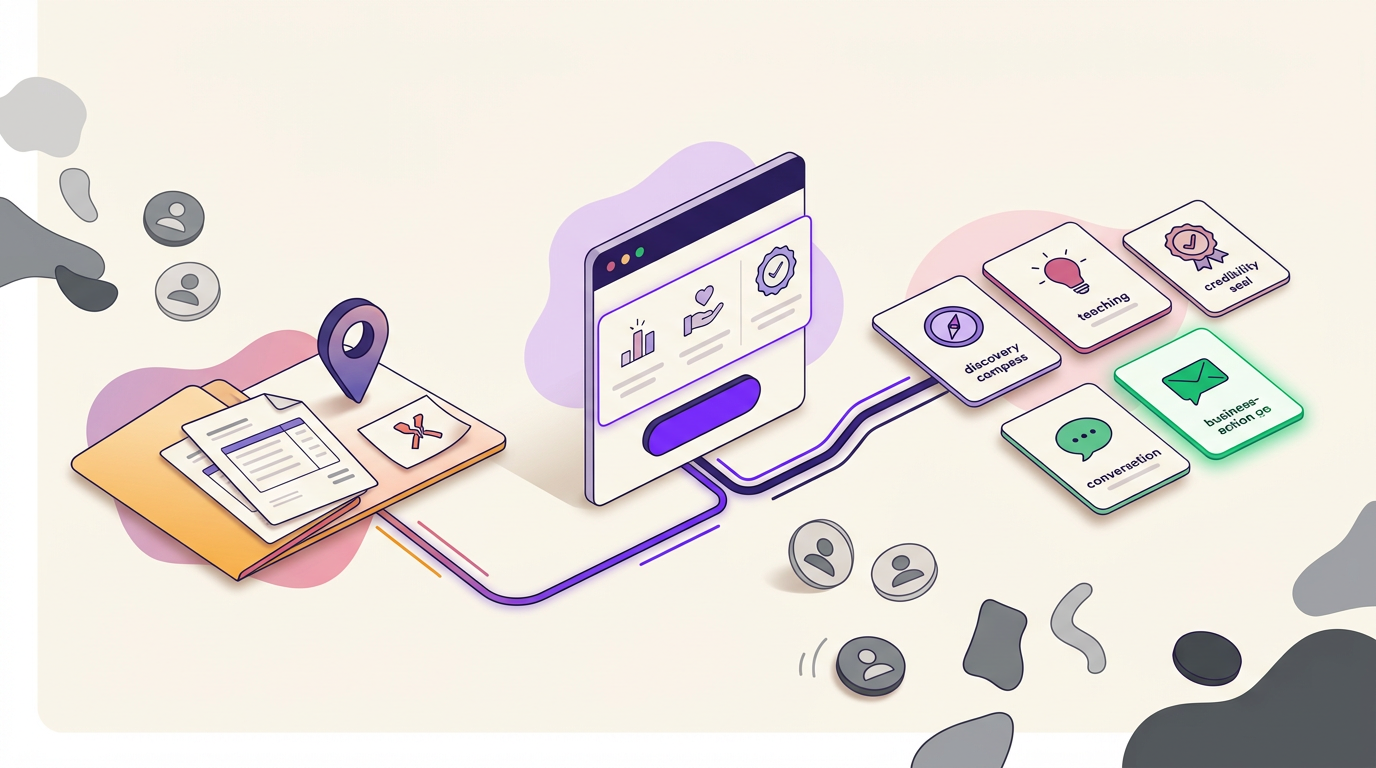
Pick the job a post has to do before picking its format. A post can exist to get discovered by new people, teach something, prove credibility, start a conversation, or push a specific business action — and each job calls for a different measure of success, not just a different format.
A conversation-focused post shouldn’t be judged mainly by clicks, and a proof post shouldn’t be judged mainly by comment count — match the measure to the job first, then judge the format against posts doing that same job. Comparisons only hold when the posts share a job and a distribution source: a post boosted with a partner share isn’t a fair comparison against a Page-only post, because the distribution source is itself a material variable.
Distribute useful posts where attention is earned
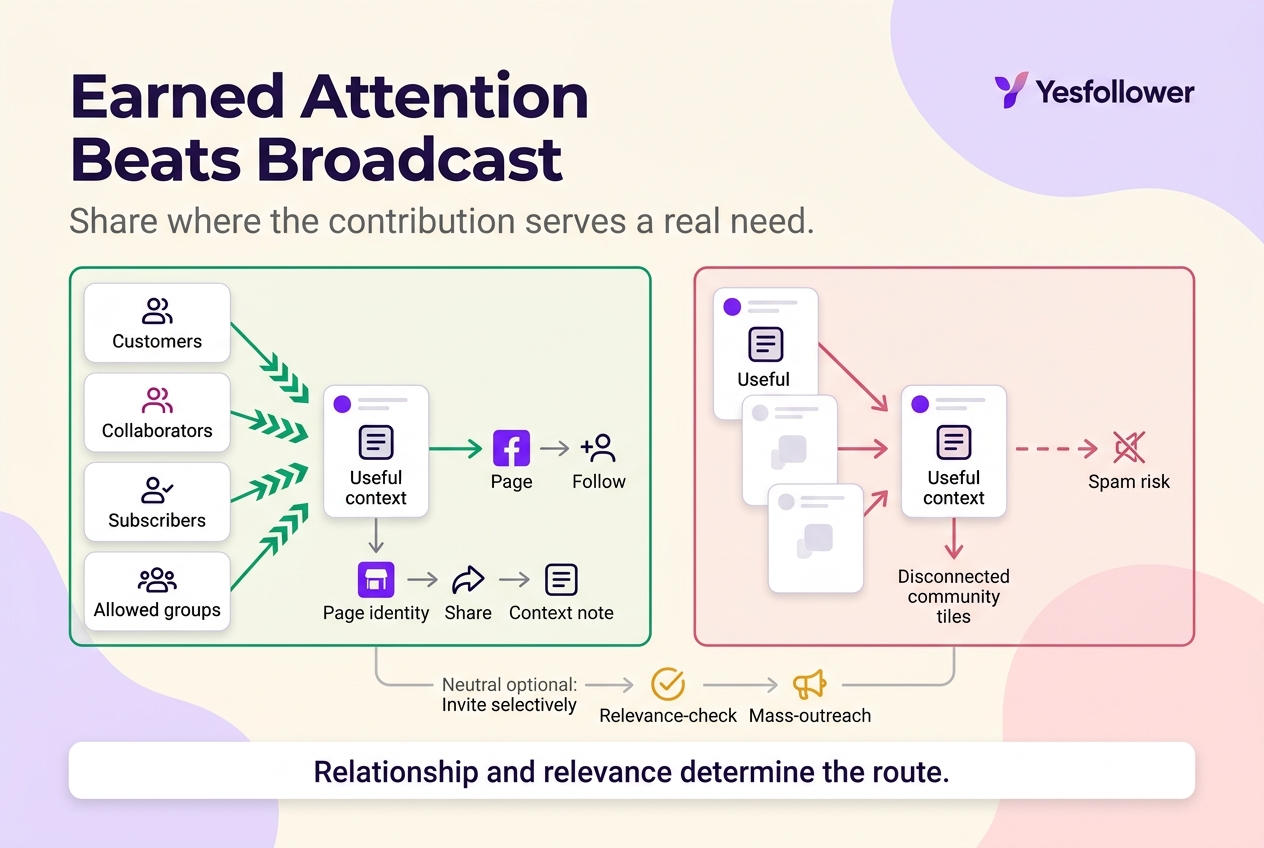
Existing customers, collaborators, email subscribers, relevant personal networks, and communities whose rules allow the contribution are channels where the audience has a legitimate reason to care about the post. Use a channel only where the relationship and that community’s own rules make the contribution appropriate — the difference between distribution and spam is whether the post serves the audience’s actual interest or just repeats the same promotion.
As documented by Facebook, a Page that has joined a group can switch into its Page identity to post, comment, react, and manage the group as the Page. A group cannot invite a Page to join, but a Page can request to join a group directly. Facebook also documents a manual path for sharing an existing Page post into a group: switch into the Page, choose Share, then Share to a group, pick the group, and optionally add context before posting. The practical test for using it isn’t whether the group is another place to drop a link — it’s whether the specific post answers a need that group’s members already have, under that group’s own rules.
Invite relevant people only when the native option is available
Reacting to a post is not the same signal as wanting to follow the Page behind it — someone might react to a giveaway or a widely shared post without caring about anything else the Page publishes. Facebook documents an Invite Friends action that lets a Page select specific profiles and invite them to like or follow it. Use it selectively, for people you have reason to think are relevant to the Page’s topic, rather than as a blanket outreach tool — the feature itself doesn’t target post engagers or verify relevance for you.
If the option isn’t available on a given Page, or most of its engagement sits on broadly promotional content, the better move is improving Page conversion and follow-up content instead of chasing a feature that may not apply to that account.
Measure the part of the growth system you intend to improve
Match the measurement to the job, not the other way around. Facebook’s Page Insights defines reach as the estimated number of unique people who saw content from or about the Page, and engagement as reactions, comments, shares, and clicks on posts; its reach figure already combines organic and paid distribution and counts a person once even where both occurred. Facebook defines impressions as the number of times content from or about a Page entered a person’s screen; reach and impressions therefore answer different exposure questions even when both appear in the same report.
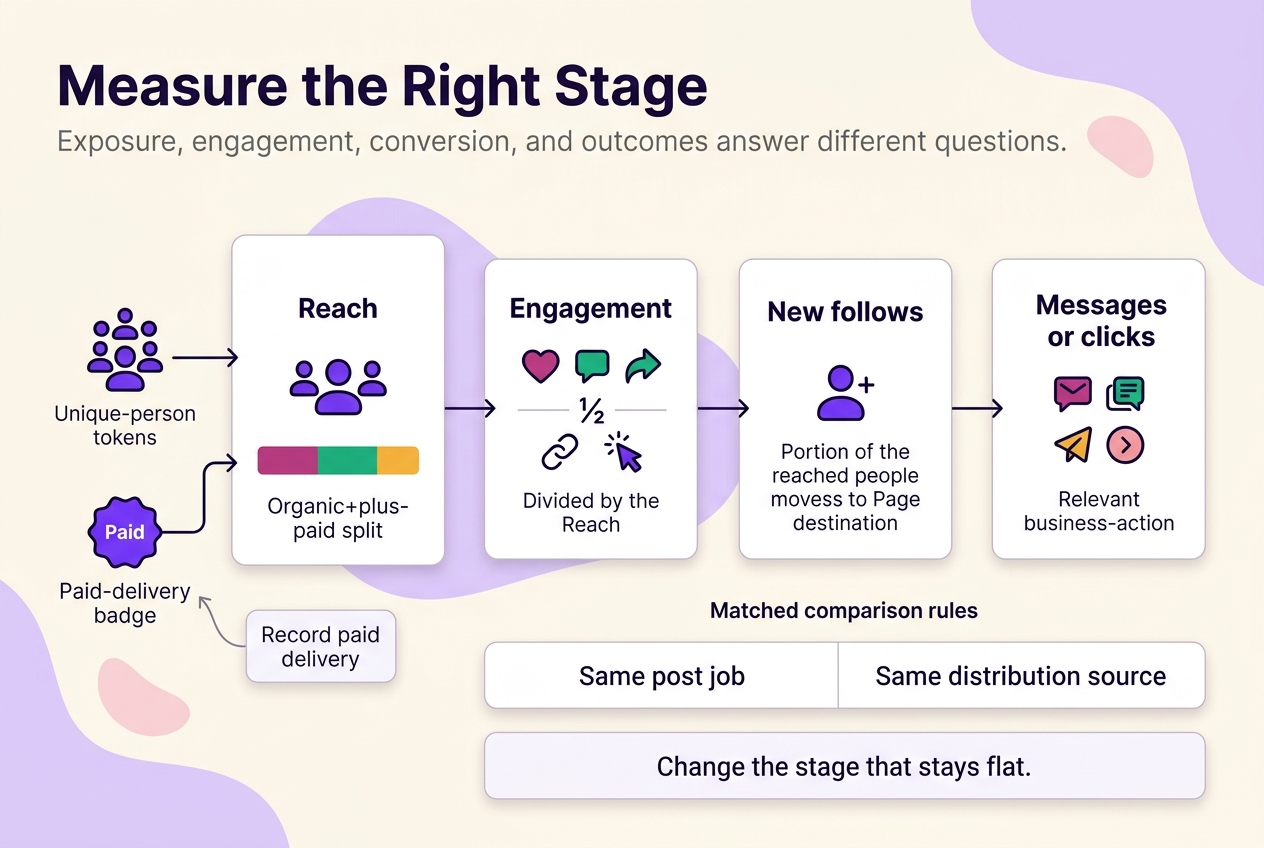
Keep these apart when deciding what to change next: reach and impressions describe exposure; reactions, comments, shares, and clicks describe engagement; new follows describe Page conversion; and messages, website clicks, or sales describe a business outcome. A reaction count climbing while follows and inquiries stay flat points at the content job, the Page’s conversion, or the distribution route — not at a policy problem, which published documentation doesn’t attribute to a single weak result.
The figures below are illustrative arithmetic only, not benchmarks to hit:
| Growth question | What to measure | Scope | Illustrative figure (non-benchmark) | Next decision |
|---|---|---|---|---|
| Is the Page reaching new people? | Reach (Page Insights) | Unique accounts that saw Page content in the period; combines organic and paid distribution | 5,000 people reached this week | If flat, review distribution routes before adding more content. |
| Is a specific post prompting real interest? | Engagement ÷ reach for that post (reactions, comments, shares, clicks) | Same post, same reporting period, same paid/unpaid treatment | 60 engaged actions ÷ 3,000 reached | If flat while reach holds, revisit the content job, not the format. |
| Is reach converting into followers and business action? | New follows and messages or clicks the Page owner tracks against reach | Owner-tracked counts per period or per comparable post — not a single Facebook-defined ratio | 25 new follows and 8 messages across a week that reached 5,000 people | If follows stay flat, audit the Page’s identity and first action; if messages stay flat, check whether the post matched what the audience needed. |
Treat each figure as a comparison against the same Page’s own history, not against another Page’s numbers or an industry benchmark — reporting scope, audience size, and paid support all differ too much between accounts for a shared threshold to mean the same thing twice.
Use paid delivery only after the organic learning is clear
Keep testing organically while the audience, the Page’s promise, the content job, the distribution route, or the success signal is still unclear. Paid delivery is worth considering only once those are defined — along with a spending limit and a paid-only measure that will tell you whether the spend was worthwhile.
The practical sequence is to fix Page conversion and confirm a content job is working organically before spending anything, because paid delivery amplifies whatever it’s fed, including a weak destination or an unclear message. The post with the most reactions is also not automatically the right one to promote; if the business needs messages or inquiries, the better paid candidate is whichever post already produces messages or inquiries organically, even with a smaller reach. Record whether a post received paid delivery when comparing results — Page Insights reach combines organic and paid distribution and counts a person once even where both occurred, so a rising reach number alone doesn’t tell you which route produced it.
Do not buy likes or automate engagement
Avoid growth tactics built around artificially inflating attention rather than earning it: buying Page likes, running bots, follow/unfollow schemes, engagement pods, automated commenting, and unsolicited bulk outreach all fall into that category. Meta defines fake engagement specifically as Page behavior that artificially boosts views or engagement to increase distribution — including documented coordinated sharing across multiple Pages and networks of fake accounts — and states that Pages using these tactics can face reduced distribution and lose monetization eligibility. Partner monetization also requires following Page-specific Terms, including restrictions on manufactured sharing.
The quieter cost is analytical, not just risk: a Page full of inactive or irrelevant followers makes every later test in this guide harder to read, because the baseline itself is no longer real.
Frequently asked questions
Two related decisions come up often enough to answer directly, without turning either into its own tactic branch.
How often should I post, and what is the best time?
No universal posting time or frequency works for every Facebook Page, so treat this as a Page-specific test rather than a rule to copy. Pick a sustainable baseline, change one variable at a time — timing, not topic and format together — and keep only the findings that repeat across more than one comparable post.
A timing comparison stops being useful the moment one period includes a paid boost, a partner share, a holiday spike, or a different topic than the other period; any of those can explain the difference on its own, independent of when the post went out.
Are Facebook Groups required to grow a Page?
No. A group makes sense only when a moderated community serves a genuine member need and allows relevant participation — a Page can grow through content, Page conversion, existing customers, collaborators, and email without ever creating one. A Page can promote an existing group it manages with a Join group button and posts about the group, but that’s a promotion option for a group that already has a purpose, not a growth requirement.
A group created mainly to repost Page promotions adds moderation work without fixing an unclear Page proposition, which is the more common bottleneck.
For the wider set of Facebook-specific guides on this site, see the Facebook growth hub.
No method guarantees a specific number of followers, views, or income. Results depend on niche, content quality, and account history.
 120,000+ creators say yes
 Real Active Accounts


 Username Generator
  Hashtag Generator
  Font Generator