Is Instagram Dying? How to Decide Whether Your Account Needs a Different Plan
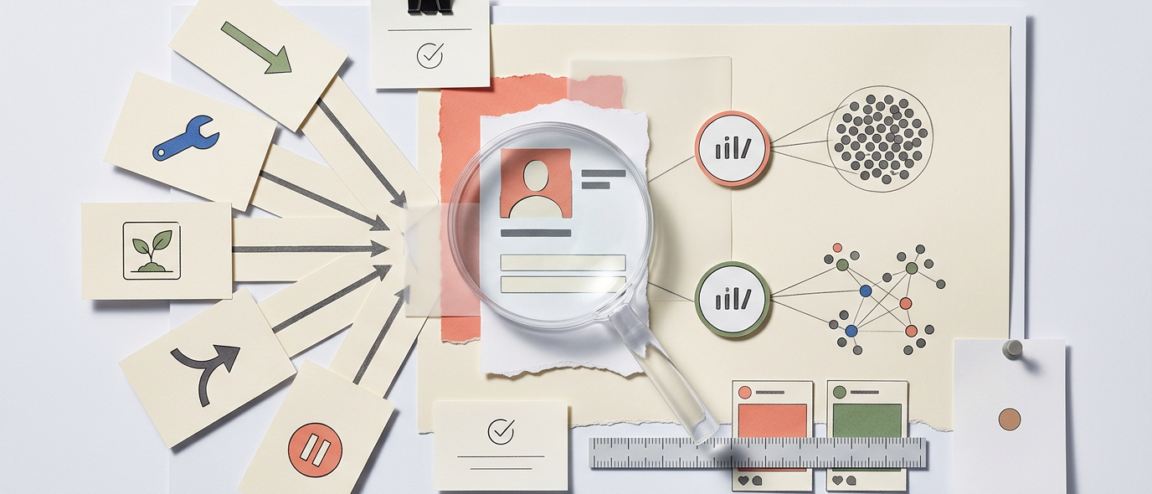
Instagram is not dying, but a stalled account often needs a different plan, not a new platform. Decide with five checks:
- Keep it if your audience and goal still fit
- Repair it when content, profile or measurement is off
- Restart only for a real audience or identity mismatch
- Diversify when Instagram works but you depend on it too much
- Pause when the evidence no longer supports the goal
If your views have dropped and growth has stalled, it’s tempting to conclude that Instagram itself is fading. A weak month on one account can’t tell you that — it can only tell you whether your content, profile or measurement match what the account is actually doing. This piece walks through what Instagram’s own policies, account tools and Insights metrics actually cover, where they run out, and how to turn a weak month into one clear decision instead of five theories. The goal isn’t to defend Instagram or bury it — it’s to get you to a single next action.
On this page
Instagram is not dead—but an account can still need a different plan
A single account’s weak month isn’t evidence that Instagram itself is failing. Published policy still governs content recommendation, Instagram’s Insights still measure reach event by event, and enforcement decisions still carry an appeal path — signs of an active system responding to individual accounts, not proof about the platform’s overall health. What a weak month can tell you is something narrower: whether this account needs a different plan.
Five decisions cover the useful options. Keep the account when your audience and goal still justify the production cost. Repair it when the audience is still relevant but positioning, content, the profile, or how you’re measuring results is misaligned. Restart only when the audience, location, subject matter, brand identity, offer, or a documented account problem makes it materially unsuitable — not simply because a month of posts underperformed. Diversify when Instagram still works but the business depends on it too heavily to absorb a bad month. Pause when the evidence doesn’t support the intended audience or goal at all right now.
A short weak stretch is the most common trigger for the wrong decision. Creators often consider deleting an account before checking whether the existing audience is still relevant, or before opening the account feedback Instagram actually provides. Acting on a feeling instead of that evidence risks abandoning a channel that still works, or continuing to publish without ever defining what the account is for.
What recommendation eligibility can—and cannot—tell you
Recommendation eligibility is a distinct, narrower thing than reach. It governs whether content from a public account can be shown to people who don’t already follow it — on surfaces such as Explore, Reels and Feed recommendations. Eligibility for those non-follower surfaces is separate from whether content reaches existing followers: an account ruled ineligible for recommendations can still have its content shown to followers, according to Instagram’s recommendation eligibility documentation.
Instagram’s creator guidance separates two different states: content that’s allowed on the platform, and content that’s eligible for recommendation. Sensitive material or repeated, unoriginal posting can be both compliant with the rules and still excluded from non-follower recommendations. Confirming eligibility tells you whether new people can be shown your content — not whether they will be, or how many.
Check official account feedback before changing the plan
Say a business account has posted consistently for a month and views have fallen by roughly half. Before rewriting the content plan, open the account feedback Instagram provides in settings — placement can vary by app version, account type and region. Account Status surfaces content removals, feature restrictions, Community Guidelines issues and recommendation-eligibility problems, though not every delivery signal a ranking system might use.
If it names a specific issue, resolve or appeal it before treating the drop as a content problem. For eligible content decisions, Instagram allows an in-app review first, and eligible cases can then be escalated to the Oversight Board within 15 days of the decision. Treat a clean result as ruling out those specific issues, then move on to comparing content like-for-like.
Viewer preferences are not an account-level diagnosis
A common mistake is reading a quiet week as proof that Instagram is suppressing an account. Instagram documents viewer-side controls — Favorites, Not Interested, Sensitive Content Control, and a 30-day snooze on suggested posts — that change what one viewer sees. These controls describe an individual viewer’s feed experience; they do not identify an account-level issue in Account Status. Check account feedback separately.
Low views are a signal, not a diagnosis
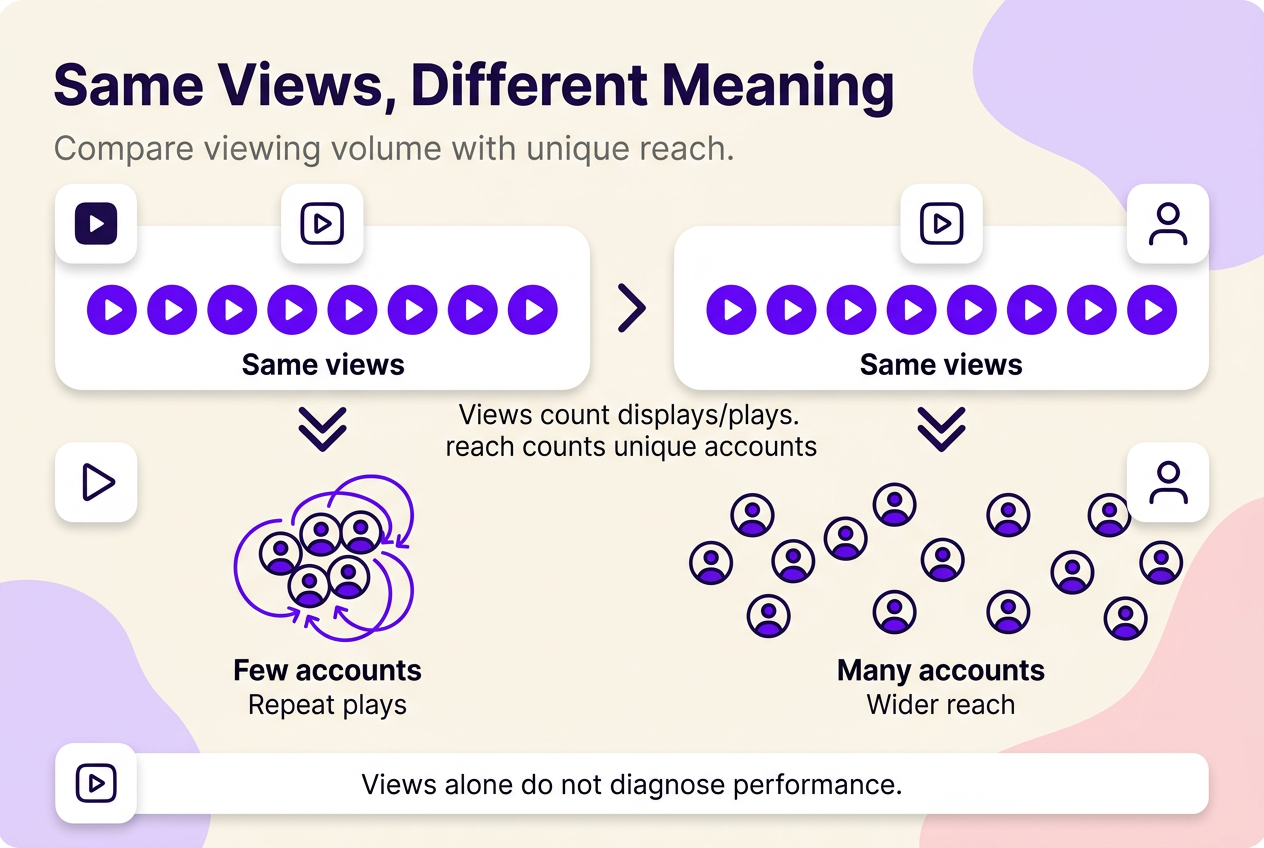
A views number that looks low is a viewing-volume figure for one post and period — it doesn’t by itself prove low reach, weak audience fit, a restriction, or a lack of business value. Instagram defines Views as the number of times content was played or displayed, an event count. Accounts reached counts unique accounts that saw the content on screen at least once, including Reels seen whether or not they were played.
Those two numbers answer different questions. Views count every time content played or displayed, including repeat plays from the same account; Accounts reached counts each unique account once, regardless of how many times it saw the content. A views figure built on relatively few accounts looks very different from the same views figure spread across many — even though the reported number is identical. Before concluding a post underperformed, compare views against reach, and compare both against a similar post from a similar period, not against a number pulled from memory or another account.
Diagnose the account before making more changes
Consider an illustrative case: a home-goods small business posts three Reels a week showing product use, and average views drop by roughly a third over a month, with no issues flagged in its account feedback. That result rules out only the issues Account Status checks for — it doesn’t identify the cause, so several explanations remain open at once.
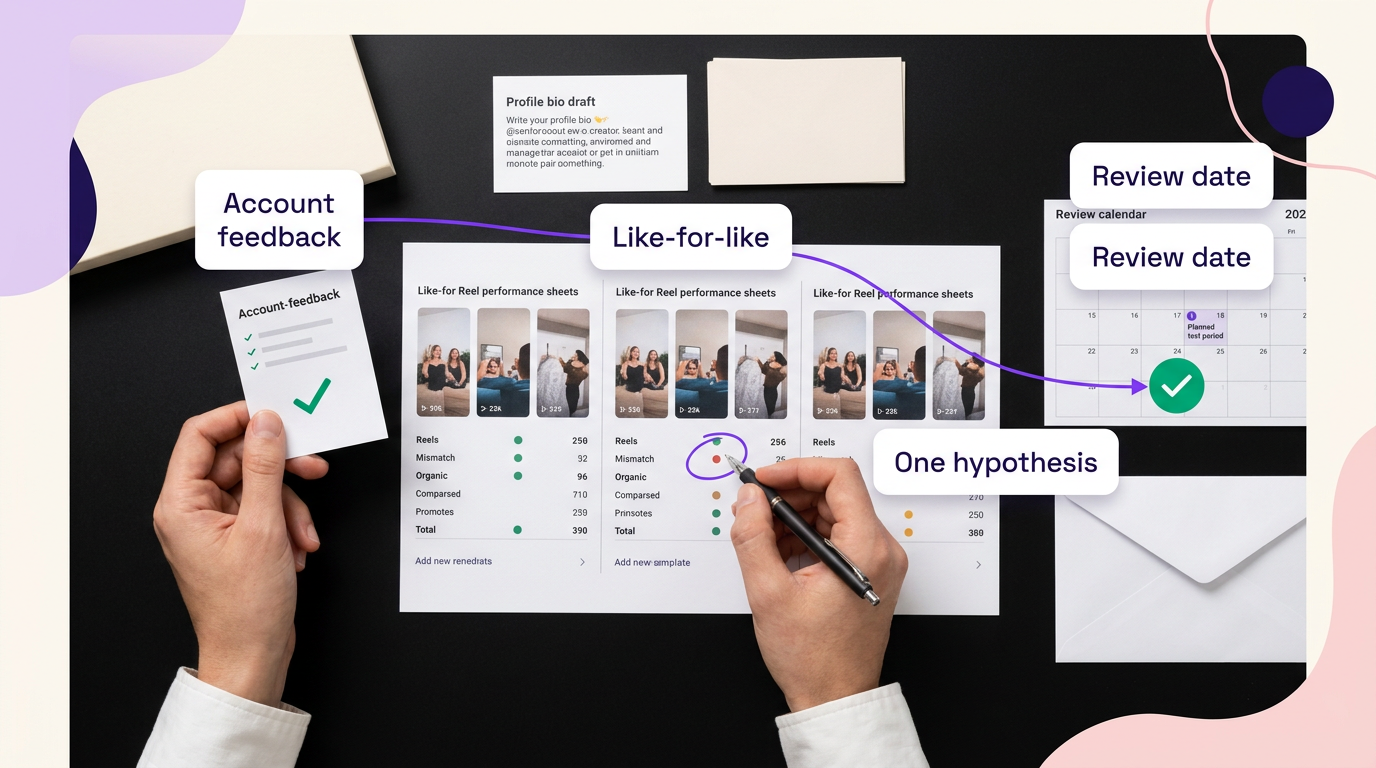
Work through them in order rather than changing everything simultaneously. First, rule out documented account or measurement issues, as above. Second, compare like-for-like organic content: same format, same posting window, same metric definition, with paid promotion excluded from the comparison. Third, test one hypothesis at a time. Common candidates include a shift in audience relevance, an unclear topic that doesn’t tell new viewers what the account is for, presentation that doesn’t hold attention in the first seconds, or a profile that doesn’t make the next step — follow, visit a link, send a message — obvious.
Each hypothesis needs its own supporting or weakening evidence before you act on it, and each controlled change should run long enough on its own to read a result. Changing the topic, format, profile and posting schedule in the same week makes it impossible to tell which change mattered.
If the audit points to inconsistent positioning or unclear goals across your content rather than one fixable post, that’s a broader planning question, covered in our Instagram marketing strategy guide.
Choose the next move: keep, repair, restart, diversify, or pause
Once the account-specific evidence is in, the decision is fairly direct, even if it doesn’t feel that way after a bad month. The table below runs on one editorial rule: choose the least disruptive action the documented evidence actually supports, and treat restart as the last resort rather than the default. A new account throws away whatever audience relevance the old one built, and diversifying pulls time and budget away from fixing what’s already there — neither is justified until repair has been ruled out.
Restart is the one move I’d only take when the account itself — not the last month of content — is the problem: a materially different audience, location, subject, brand identity, or offer than the one it was built for, or a documented account condition that resolution or appeal genuinely can’t fix.
| Account condition | What it usually means | Evidence to review | Next action |
|---|---|---|---|
| Audience and goal still fit; results are acceptable for the effort | The account is doing its defined job | Trend in the metric tied to that job; profile actions | Keep: maintain the current approach |
| Audience is still relevant, but content, profile, or measurement is unclear | A fixable execution problem, not a platform problem | Account feedback; like-for-like content comparison; profile destination | Repair: change one variable at a time |
| Audience, location, subject, brand identity, or offer no longer matches the account | A structural mismatch content changes won’t fix | Current audience relevance; offer fit; account feedback history | Restart: rebuild deliberately, only after repair is ruled out and any documented account issue has been resolved or appealed |
| Instagram still supports discovery or trust, but the business depends on it entirely | A useful channel with risky concentration | Where inquiries or sales currently originate; owned-destination presence | Diversify: add an owned next step alongside Instagram |
| Evidence doesn’t support the intended audience or goal right now | Continued investment isn’t justified at this point | Production cost versus outcome over a defined period | Pause: reduce or stop investment; redirect effort |
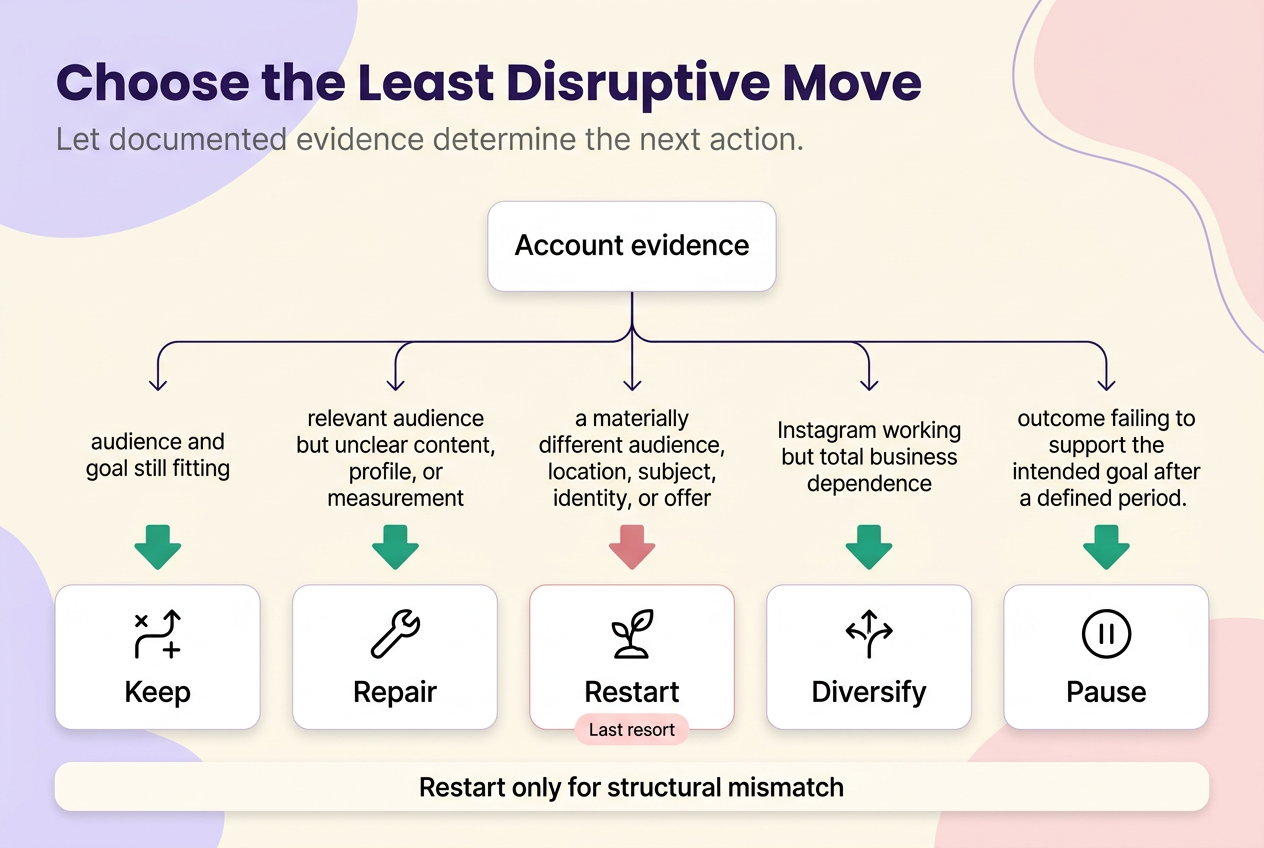
Do not start a new account just because growth is slow
Slow growth by itself isn’t a reason to start over. A restart erases whatever relevance the account already has with its existing audience, and it doesn’t fix an unclear offer, inconsistent subject matter, or an undefined goal — those follow you to the new account. Restart is defensible when the account was genuinely built for a different audience, location, or purpose than the one you’re running now, not because last month underperformed.
Growth has no universal timetable
There’s no defensible universal timetable for Instagram growth, because it depends on account type, category, content format, and what “growth” is meant to achieve — follower count, qualified inquiries, or something else entirely. No credible timetable applies equally to a food brand posting Reels and a consultant posting carousels.
What you can set is a review point. Pick a period long enough to publish several comparable posts, and decide in advance what result would justify continuing as-is, what result would justify changing one variable, and what result would justify pulling back. Compare that period against your own account’s baseline, not against a number you saw somewhere else.
Give Instagram one job and measure that job
Instagram can serve different jobs for different accounts — relevant discovery, credibility, community support, product interest, or qualified inquiries — and the metric that matters changes with the job. A follower count tells you little about whether a service business is generating inquiries; a broad views number tells you little about whether a creator’s audience is engaged enough to keep watching.
Where a ratio is useful, define the numerator and denominator before you calculate it. As illustrative arithmetic only: if a post reaches 2,000 unique accounts and receives 150 interaction actions — likes, comments, saves and shares combined — that’s 150 ÷ 2,000, or 7.5%. This mixes an event count (interactions) with a unique-account count (reach), so treat it as a rough comparison between two posts, not a per-person engagement rate. It says nothing about whether 7.5% is good, and it isn’t a claim about how any recommendation system weighs interactions.
Match the metric to the job, not the other way around. Discovery goals track best against Accounts reached compared across similar periods; community or engagement goals track against Accounts engaged and Interactions; a lead or inquiry goal depends on qualified inquiries recorded wherever your business actually logs them — a form, inbox, or CRM — since Instagram’s own reporting doesn’t attribute those outcomes natively. Pick the one or two numbers that match your account’s job, and judge them against your own history rather than a borrowed benchmark.
Run a seven-day review before making a reset decision
Run this before deciding to reset or deprioritize anything:
- Open your account’s feedback tool and note anything it flags — removals, restrictions, or eligibility issues.
- Write down the one job this account is meant to do this quarter.
- Pull three recent posts in the same format and compare views, reach, and interactions against three posts from your strongest period.
- Check your profile: does it make the next step — follow, visit, message — obvious to a first-time viewer?
- Pick one hypothesis from the mismatches you found and make one change tied to it.
- Set a date to review the result before making a second change.
The output that matters is one written decision and one condition that would change it — not a longer list of things to try. Finishing the week with five new ideas and no controlled change means you’ve collected opinions, not evidence.
If the account itself checks out and you’re ready to execute growth tactics rather than diagnose the account, that work belongs in how to grow Instagram followers.
Keep Instagram useful without making it your only audience asset
Diversifying doesn’t mean opening five more social accounts. If Instagram still supports discovery, credibility, or community for your account, the first useful layer outside the platform is usually one owned destination — a website page, an email signup, or a defined inquiry process — that interested people can move to. Instagram keeps introducing people to the business; the owned destination keeps that relationship going somewhere you control.
For the planning and execution work that follows this decision, the Instagram Growth hub is the next stop.
No method guarantees a specific number of followers, views, or income. Results depend on niche, content quality, and account history.
 120,000+ creators say yes
 Real Active Accounts


 Username Generator
  Hashtag Generator
  Font Generator