
Influencer Marketing Platforms: How to Choose the Right Instagram Workflow
Choose an influencer marketing platform by identifying the operational bottleneck: use a manual pilot for a contained first campaign, a creator database or marketplace when sourcing fails, campaign-management software for approvals and records, affiliate or attribution tools for commission reconciliation, and a managed service when execution capacity is limited.
Software selection should follow identification of the current operational bottleneck — sourcing, approvals, payment records, or measurement — not precede it. Buying a platform before naming that bottleneck usually means paying for a tool that solves a problem you don’t have. This guide walks through the operating models available to a US-based Instagram brand running creator campaigns, how to tell which one matches your actual bottleneck, and what a manual first campaign looks like before you commit to any subscription. It also covers the parts no dashboard settles: creator vetting, real campaign cost, rate negotiation, and how to define ROI before launch instead of after.
Which influencer marketing platform should an Instagram brand choose?
An influencer marketing platform isn’t one product category — it’s shorthand for several different operating models, and the right choice depends on which part of your creator-partnership process is actually failing, not on which vendor has the biggest marketing budget.
If you’re running a first campaign with no backlog of outreach, start with manual coordination: a shortlist, direct messages, and a shared record. If sourcing candidates is the constraint — you don’t know who to approach — a creator database or an opt-in discovery marketplace solves that specific problem, provided the creator on the other end has actually opted in and remains eligible under that platform’s current criteria. If the bottleneck is approvals, deliverable tracking, or keeping records straight across several creators, campaign-management software or a lightweight CRM addresses coordination, not sourcing. If the campaign runs on commission and success is defined by attributed purchases, affiliate or attribution software becomes worth considering once commission reconciliation across multiple creators is the documented bottleneck and manual records can no longer keep up. If the real constraint is hours — your team can plan the campaign but can’t execute outreach, negotiation, and reporting at volume — a managed service adds staffing, not a new dashboard.
The table below breaks these models into the specific work each one solves, the records it requires, what to measure while using it, and the judgment calls that stay with your team regardless of which one you choose.
| Operating model | Primary bottleneck it solves | Records you need to keep | What to measure while using it | Human work that stays with your team |
|---|---|---|---|---|
| Manual coordination (no software) | None yet — validates whether a real bottleneck exists | Outreach, terms, and cost logged by hand | Whether a repeated failure shows up at all | All outreach, negotiation, and reporting |
| Creator database or marketplace | Finding candidates who match your audience and niche | Source and provenance label for every profile | Confirmed interest and eligibility before outreach | Vetting, negotiation, and relationship management |
| Campaign-management software or CRM | Approval routing, deliverable tracking, and coordination across creators or stakeholders | Brief, contact/status log, revision history, and usage-rights terms | Deliverable status, turnaround time, and reporting consistency | Creative judgment, brand-safety review, and rights negotiation |
| Affiliate or attribution software | Reconciling commission-based sales across creators | Link or code assignment, commission terms, order data | Tracked conversions and commission payouts | Interpreting incrementality and profit impact |
| Managed service | Insufficient internal hours to run the program | Scope of work and reporting handoff terms | Whether the service’s reporting matches your cost boundary | Final approval and legal sign-off |
Match the row to your current constraint before comparing vendor demos — a tool built for discovery won’t fix an approval bottleneck, and a CRM won’t source a single new creator.
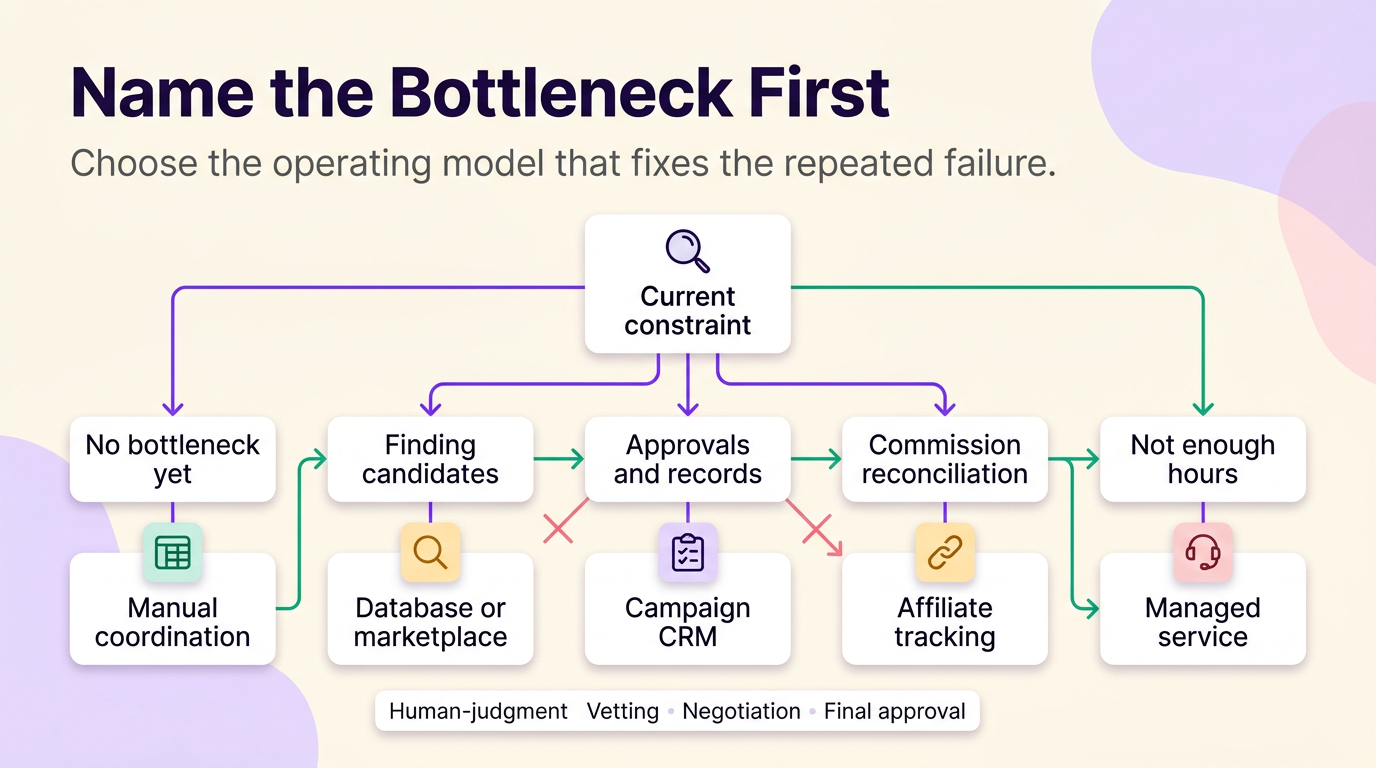
Manual workflow, database, marketplace, CRM, affiliate system, or managed service
These terms get used interchangeably in vendor marketing, but they describe different things. A manual workflow is you and a spreadsheet — no third-party data source at all. A creator database indexes potential creators from public profiles and content signals; being listed doesn’t mean the creator knows the tool exists. A marketplace, by contrast, represents creators who opted in or built a profile specifically to receive brand offers — a different starting point than an indexed database entry, though marketplace enrollment and current availability still need verification against your specific product and campaign. Creator relationship management software organizes contacts, outreach status, and approval history once you already have names to manage. An affiliate or attribution system supports commission arrangements and records the commerce activity tied to a tracked link or code. A managed service supplies people who do the outreach, negotiation, and reporting for you. Some vendors bundle two or three of these functions into one product, but a bundled feature list doesn’t change what each function actually verifies.
Feature names, eligibility rules, and menu placement for any native discovery tool vary by account type, region, and app version, so confirm current details directly in Meta’s own documentation before relying on them.
A profile appearing in a database, or even in a marketplace, isn’t the same as a creator who is available, interested, or authorized to collaborate on your specific campaign — confirm that separately before treating the listing as a lead.
What platform software can—and cannot—centralize
The common mistake is assuming a completed step inside a dashboard means the underlying business decision is settled. A payment marked “complete” doesn’t confirm that usage rights, exclusivity, or disclosure terms were actually agreed — only that money moved.
Depending on the product, a platform can centralize creator discovery, contact records, outreach workflow, approval routing, payments, affiliate tracking, or performance reporting. Instagram’s own Insights defines views, reach, and interactions as count metrics inside the app. As of August 2026, Meta Ads Manager reporting includes ad reach, clicks, and spend, and Commerce Manager reports catalog views, wishlist adds, and purchases for a connected shop. Each of those reports measures a different activity — content views, ad performance, or shop activity — and none of them is a creator-attribution system on its own; define and validate your own tracking method before treating a sale as connected to a specific creator’s post.
Software also doesn’t decide whether a creator’s audience actually overlaps with your customers, whether their content matches your brand, or whether the agreement’s rights language covers how you intend to use the content. It organizes the paperwork trail; it doesn’t make the underlying call.
Start with the campaign output, not the software demo
Comparing platforms before defining what the campaign needs to produce is where most software evaluations go wrong. Define one primary output before evaluating anything: awareness activity, creator-produced content assets you’ll reuse, product seeding, affiliate-attributed sales, or an ongoing ambassador relationship. That single choice determines what evidence you need from a creator, how compensation should be structured, what tracking must be in place before the first post, and which report you’ll actually read afterward. A campaign built around three simultaneous primary goals — reach, sales, and a content library — usually ends up unable to pay creators consistently or judge success cleanly, because each goal implies a different creator profile and a different payment structure. Pick one primary output. Log the others as secondary and don’t let them drive the budget.
A small-business pilot without a platform subscription
Run a manual pilot as a defined sequence rather than open-ended outreach: choose one primary output before contacting anyone; build a short list from existing customers, tagged mentions, or direct content research; write one paragraph defining deliverables, disclosure expectations, and a posting window; assign a unique tracking link or discount code to each creator before outreach goes out, not after; and log every cost — product, shipping, flat fee — in one spreadsheet row per creator. At the end of the defined window, compare tracked activity against total spend, and check the outreach thread for any creator whose code or link went unused before assuming the content itself underperformed — a scheduling delay and a content problem look identical in the numbers alone.
Start manually when the shortlist and workflow are small enough for your team to manage directly — when disclosure and rights terms can be reviewed by hand and there’s no proof yet that sourcing, approvals, or reconciliation is failing at volume. This is a starting-point judgment, not a rule that fits every catalog size or team: move to software once a specific, repeated bottleneck, not a hoped-for one, shows up in that manual record.
Finding and vetting Instagram creators
Source Instagram creator candidates from four places: existing customers and tagged mentions, a documented creator database or marketplace, direct content research inside your niche’s hashtags and locations, and referrals from creators you’ve already worked with. None of those four sources by itself qualifies a creator for outreach — sourcing only produces a longlist.
Before contacting anyone, run each candidate through separate checks: does their visible audience overlap with your customer base (audience relevance); does their existing content and product history fit your brand (content and product fit); can they confirm deliverables, timelines, and reporting commitments directly, through your own communication with them rather than an inference from past posts (professional reliability); does their content history raise brand-safety concerns; and can they actually provide the reporting inputs your measurement plan requires (measurement readiness)? Label the evidence behind each check honestly: a public bio is a public observation, a number the creator sends you is creator-provided, a stat pulled from Instagram’s own Insights is platform-reported, and anything from a third-party estimation tool is exactly that — an estimate, not a verified number.
None of these checks, individually or combined, proves that a creator’s audience is authentic — they establish fit and reliability, not a fraud verdict.
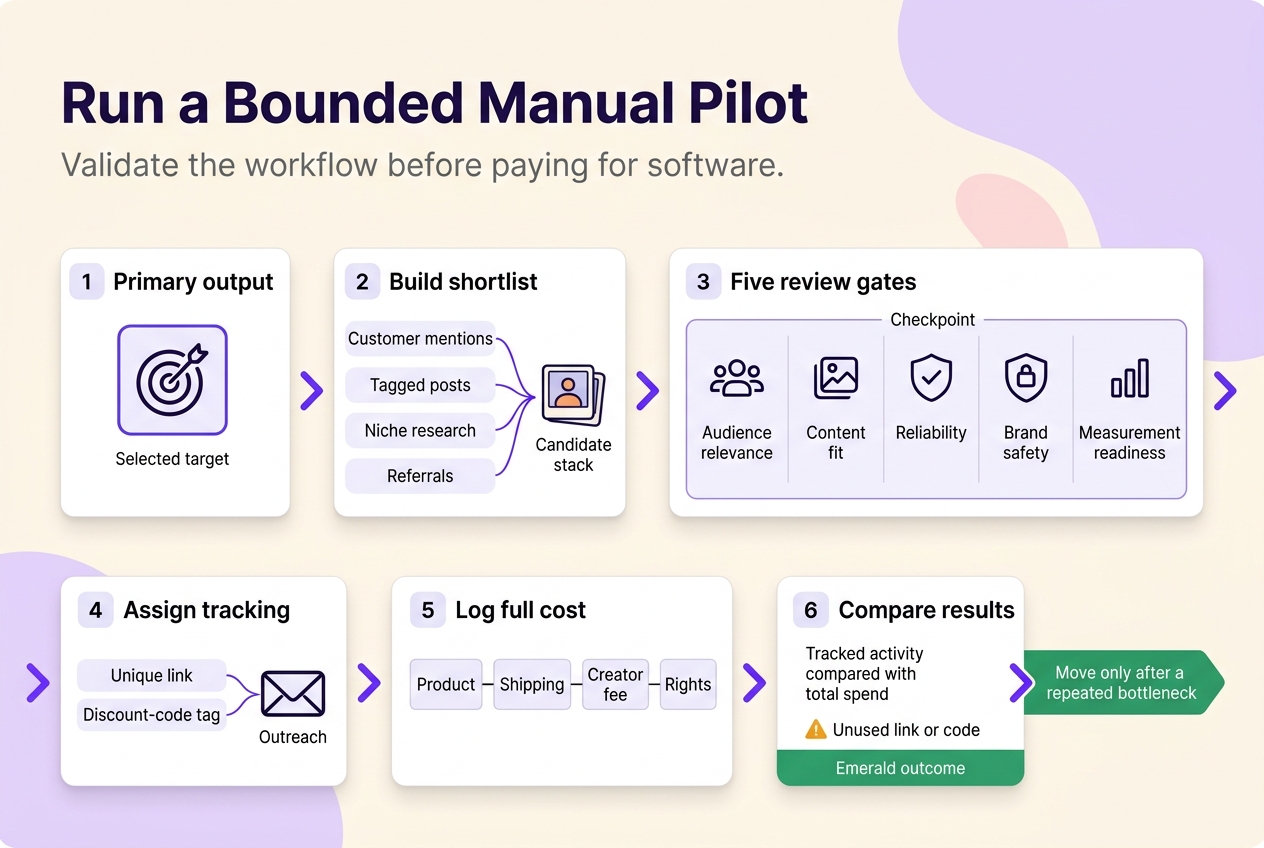
Five review gates before outreach
The mistake is collapsing five separate checks into one gut-feel score. Audience relevance, content and product fit, professional reliability, brand safety, and measurement readiness each need their own evidence and their own advance-or-reject decision — a creator can pass four gates and still fail the fifth. Measurement readiness belongs before outreach, not after content goes live: a creator who can’t or won’t provide the reporting input your ROI plan depends on — creator-provided performance figures, a confirmed tracking link, an agreed reporting cadence — can invalidate your comparison across creators regardless of how good the content turns out to be. Label anything a creator sends you as creator-provided, not platform-verified. Record why each candidate advanced or was rejected; the reason matters more than the tally.
Campaign cost is more than the creator fee
The mistake that blows budgets is treating a creator’s quoted fee as the campaign cost. Build the real number from nine line items: creator compensation, product and shipping, production or revision costs, content-use rights, exclusivity, any paid amplification spend, platform or agency fees, affiliate commissions, and your own team’s hours managing the relationship.
Two categories get skipped most often and cause the most disputes: content-use rights and exclusivity. A quote that looks affordable in cash can cost far more in practice if the rights grant covers unlimited paid use across every channel for a year, or if exclusivity locks the creator out of competitor work for a period that limits your own options. Price those two terms explicitly, in writing, before comparing quotes — a lower fee with broader rights isn’t automatically the cheaper option. Keep every category inside one defined campaign period so the total lines up with how you’ll calculate ROI later.
Negotiate scope before negotiating the influencer rate
Negotiating the rate and negotiating the scope are two different conversations, and doing them in the wrong order is why quotes feel arbitrary. Before asking for a lower number, define deliverables, format, publishing timing, number of revisions, usage rights, exclusivity, disclosure expectations, which reporting inputs the creator will provide, payment timing, and any performance-based component. Once scope is fixed, negotiate by trading scope elements — narrower usage rights, one fewer revision round, a shorter exclusivity window — rather than asking a creator to do the same work for less money. A rate card is a starting quote, not a finished agreement.
Rights, exclusivity, and payment-structure language carry real legal weight, so put final terms in a written agreement rather than a DM thread; a contract template built for creator partnerships is a reasonable starting point for that document.
Measure ROI with an attribution plan set before launch
The usual advice — “track sales and calculate ROI after the campaign” — fails because the definitions that make ROI meaningful have to be set before launch, not after you’re looking at a number you like. Before the first post goes live, define five things: the campaign objective, the total-cost boundary (using the full breakdown from the cost worksheet, not the creator fee alone), the tracking method, the attribution window, and the value basis you’ll use — tracked revenue, gross profit, or commission value.
Once those are fixed, the formula is straightforward: ROI equals defined attributable value minus total campaign cost, divided by total campaign cost. Decide before launch exactly how your tracking setup will record sales associated with each creator — a link, a code, or a platform report — and treat that record as attributed, not automatically incremental: neither a redemption count nor an Insights export tells you whether those sales would have happened anyway, and revenue isn’t profit until you apply your value basis.
Fix your attribution window as part of that pre-launch definition, independent of any dashboard’s display options — the window is a decision you make, not a setting the report hands you. If a creator’s content mix includes Stories, note the metrics differ from Feed content: Story reach counts unique accounts that saw the story at least once, and Story interactions include replies, shares, sticker taps, and link taps, so mixing Feed and Story numbers without labeling the source produces an inconsistent total. Report the final figure using the exact value basis and cost scope you defined at the start, and use the same definitions for every campaign you compare, or the comparison itself becomes the source of error.
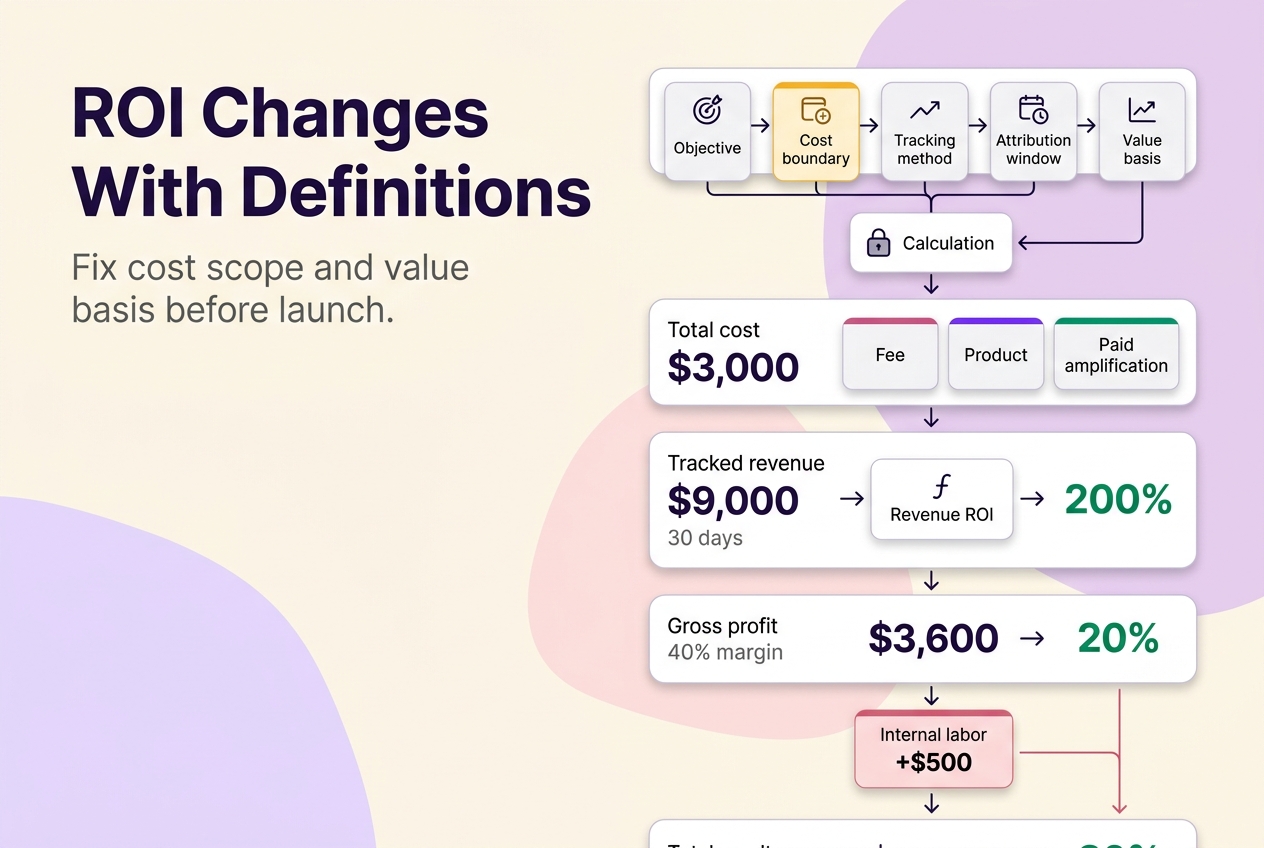
Illustrative ROI arithmetic and its boundary
Illustrative arithmetic only, not a benchmark: assume a campaign with $3,000 in total campaign cost (fee, product, and paid amplification combined) and $9,000 in tracked revenue over a 30-day attribution window. Using revenue as the value basis: ROI = ($9,000 − $3,000) ÷ $3,000 = 2.0, or 200%. Switch the value basis to gross profit at a 40% margin — $3,600 — and the same campaign becomes ($3,600 − $3,000) ÷ $3,000 = 0.2, or 20%. Add a previously omitted cost, such as $500 in internal labor, and the profit-basis result drops further. The arithmetic doesn’t change; the assumptions behind “attributable value” and “total cost” do, which is why two campaigns can’t be compared unless both use the same value basis and cost scope.
Disclosure, rights, and paid-use checks before publishing
Complete four separate checks before creator content goes live, because Meta’s requirements and US disclosure law are related but not identical.
First, confirm the post discloses any material connection — payment, free product, or a business relationship — clearly and conspicuously, consistent with the FTC’s revised Endorsement Guides, effective July 26, 2023; a hashtag placed anywhere in a long caption doesn’t automatically meet that standard.
Second, confirm the branded-content side separately: Meta requires branded content to be posted using its branded content tool, with prior permission from the tagged brand, and creator guidance says a Paid Partnership label is required whenever a creator is paid in any form. Once enabled, that disclosure can run across Feed, Stories, Live, Reels, and video — the tool covers the surface, not the legal duty behind it.
Third, if you plan to boost the post, check the tagging limits: a post can carry up to two brand-partner tags, but a post with more than one brand partner can’t be boosted. As of August 2026, partnership ads require the creator to have a professional account and comply with Instagram’s Partner Monetization Standards, Community Guidelines, and Content Monetization Policies.
Fourth, confirm the written agreement’s content-use permissions actually cover your intended use — clearing Meta’s label satisfies Meta’s rule, not your contract.
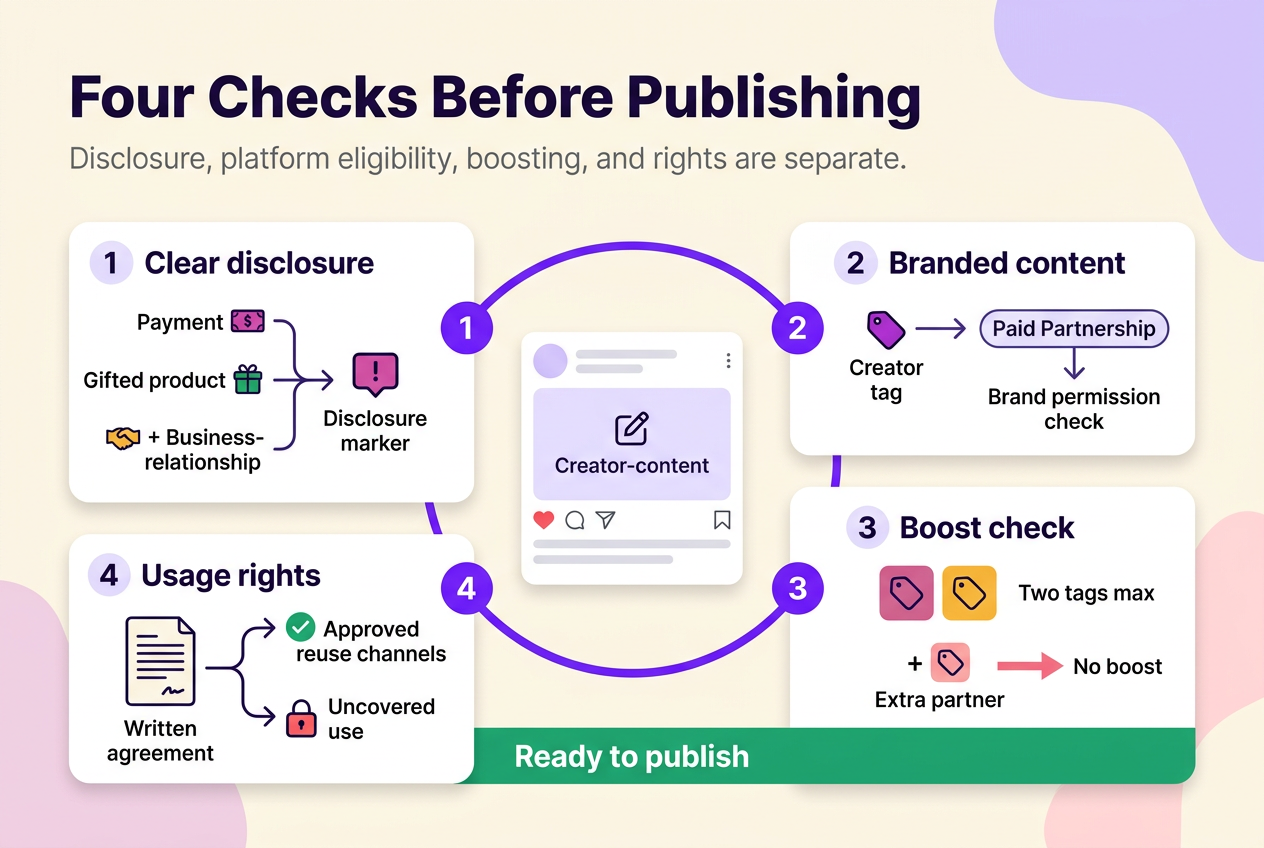
Choose one workflow and run a bounded pilot
Match your current bottleneck to one of the models above, write down one campaign objective and the single measurement method you’ll use to judge it, and keep a record of every candidate you rejected and every cost you paid — not just the creators you hired. That record, not a vendor comparison chart, is what tells you whether manual coordination, a marketplace, campaign software, affiliate tracking, or a managed service is actually justified next. For more on turning an Instagram account into a revenue channel, see the Instagram Business & Monetization hub.
This guide explains Meta’s branded-content and disclosure requirements and general FTC endorsement principles; it is not legal advice. Have a qualified US attorney review usage-rights, exclusivity, and compensation terms before you sign a creator agreement.
No method guarantees a specific number of followers, views, or income. Results depend on niche, content quality, and account history.
 120,000+ creators say yes
 Real Active Accounts


 Username Generator
  Hashtag Generator
  Font Generator