Free Instagram Followers: What “Free” Costs Before You Enter Your Login
Free Instagram followers typically come through native actions, reciprocal exchanges, or third-party services. Native actions trade time and content; reciprocal exchanges trade ongoing obligation; third-party services can require login credentials or account permissions. The safest choice protects account control while building reach through content and relevant collaborations.
- Native features that trade your time and content, not access
- Reciprocal exchanges that trade your following for someone else’s
- Third-party services that ask for login credentials or account permissions
You’re on a site promising free followers, and the only thing standing between you and the button is a login field. That single decision splits into three separate questions: what you get, what the account gives up, and what the platform’s own rules say about it. Some of what gets called “free” is just Instagram’s own features used well; some is a trade with other accounts; and some asks for access you may not be able to take back. The difference matters more than the follower count, because the bill for a shortcut usually arrives weeks later, in your metrics rather than your inbox.
Can you get free Instagram followers safely?
Sometimes, and what “safely” means depends on which of three things you’re actually doing, because each one carries a different exposure. Native actions — profile work, publishing, collaborations you arrange yourself — cost time and effort, not account access. Reciprocal exchanges cost obligation: you follow or promote in return for the same, and the arrangement only holds while both sides keep reciprocating. Access-requesting services cost control over the account itself, and that’s the one category that needs scrutiny before you approve anything, whatever the price tag says.
Three routes that get called “free”
Every “free followers” offer collapses into one of three mechanisms, and the mechanism — not the marketing page — decides what it costs you. A relevant creator collaboration is not the same as a count-building follow swap, and typing your public handle into a form is not the same as authorizing an app to act on your account. The table below lines up all three against the same four questions: what you get right away, what your account gives up, what Instagram’s published rules say, and what’s worth checking a month later once the initial bump settles.
| Route | Immediate benefit | What your account gives | Policy posture | One-month check |
|---|---|---|---|---|
| Native actions | Reach built from your own content and audience, no external delivery | Time and content, no access | Doesn’t involve third-party access; not a category the public guidelines address directly | Same account, more content published, no access history to review |
| Reciprocal exchanges | A higher follower count, quickly | Obligation to keep reciprocating | Guidelines prohibit artificially collecting followers; unpaid swaps aren’t named directly | Count up — compare engagement against your pre-swap baseline |
| Access-requesting services | A promised follower delivery | Login data or app authorization | Instagram removes activity tied to popularity-boosting third-party apps | Check against Instagram’s stated removal of inauthentic activity tied to these apps, and review what access you granted |
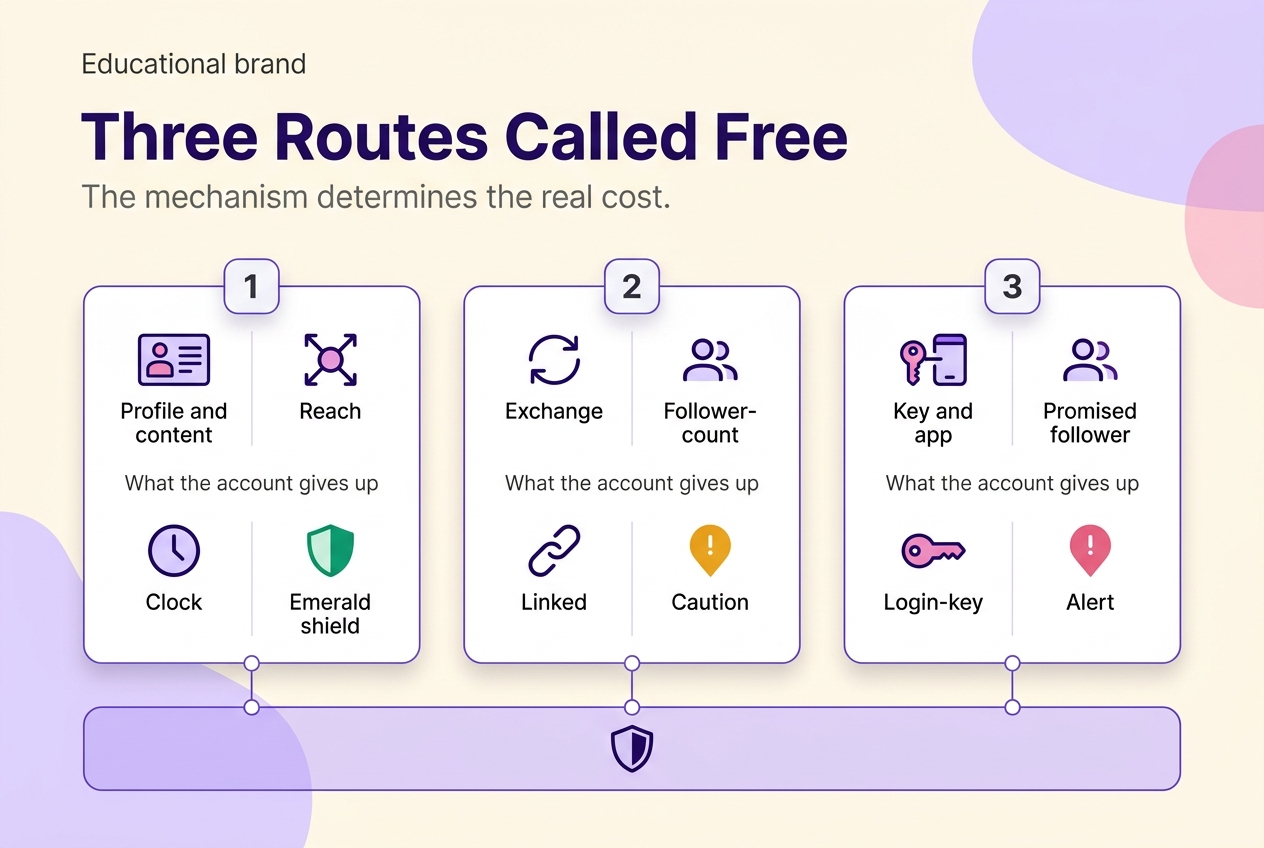
Native platform actions
Native actions run through parts of Instagram you already control: your profile, your captions, and the collaborations you choose to arrange. None of it requires handing over a password or trading follows with strangers — it requires the thing that’s actually scarce on a zero budget, which is time. A complete profile, a posting rhythm you can sustain, and content built for the audience you already have are the levers here.
What you get is reach built from your own effort rather than delivery from an outside source. What your account gives up is attention and hours, not data or access. A month later, you’re looking at the same account you started with — more content published, nothing to explain on the access side.
Reciprocal exchanges
Reciprocal exchanges — commonly labeled F4F or S4S — trade a follow, a shoutout, or a comment for the same thing back. What you get is a higher follower count, quickly, at least at first. What your account gives up is an obligation: you follow accounts you may not actually care about, or promote content that has nothing to do with your audience, and the swap only holds together while both sides keep reciprocating.
Instagram’s Community Guidelines prohibit artificially collecting likes, followers, or shares, and offering money for engagement — but the published wording doesn’t name unpaid reciprocal follows directly, so a manual follow-for-follow swap sits in territory the public rules don’t spell out, not territory they explicitly clear. Read that as caution, not permission.
A month later, the check to run is whether that follower count still sits beside comparable engagement, or whether engagement has moved on its own, independent of the count.
Services that request account access
Services that promise followers for free ask for something in return — that might be a public handle, or it might be an email, a password, or authorization for a connected app to act on the account’s behalf. “Free” describes the price, not the request. Assess the request itself: is it asking for a handle you’d give anyone, or for credentials, or for standing authorization for a connected app?
Instagram has said it removes inauthentic likes, follows, and comments generated through third-party apps used to boost popularity, and treats those apps as a violation of its Community Guidelines and Terms of Use. That’s a stated consequence tied to the account, separate from whether the delivered followers look real or not.
A month later, the check here isn’t just the follower count — it’s whether Instagram’s stated removal of inauthentic activity tied to popularity-boosting apps has touched the account, and whether the access you granted is still something you understand and can control.
F4F, S4S, pods, and “growth hacks” are labels, not safety ratings
Treating F4F, S4S, pods, and “growth hacks” as safety ratings is the mistake — they’re names for behaviors, and the behavior is what matters, not the acronym.
In practitioner use, F4F means a reciprocal follow: you follow, they follow back. S4S means reciprocal promotion — a shoutout traded for a shoutout, which can describe a relevant collaboration between accounts with overlapping audiences or a pure count-building exchange with no audience fit; the difference is the disclosed purpose and whether the two audiences actually overlap. Engagement pods describe a coordinated group that likes and comments on each other’s posts on a schedule. Follow-unfollow describes following a batch of accounts hoping for follow-backs, then unfollowing them later, done manually or through automation. “Growth hacks” gets attached to everything from ordinary profile optimization to the tactics above — the label alone doesn’t tell you which one you’re looking at.
None of these are official Instagram categories; they’re practitioner shorthand. The useful question isn’t which acronym applies but what the account is actually being asked to do.
At the login screen, use a stop rule—not a no-password test
The advice “never give out your password” fails the moment a service doesn’t ask for one — and plenty of follower services don’t. They ask for a handle, then an email, then permission to “connect” an account, and each step feels smaller than the last. Judge the request by what it actually asks for, not by whether a password field appears. Menu names for the checks below vary by app version, account type, and region, so treat the underlying request as the constant and your own settings as the place to find the current equivalent.
Here’s the order I’d use: first, is this request for a public handle, something already visible to anyone? Low stakes. Second, is it asking for an email or phone number tied to the account? A step up — that’s additional account-linked information, not just a contact detail. Third, is it asking to log in as you, or to authorize a connected app with standing access to act on the account’s behalf? That’s the point to stop until you understand exactly what the app can do and how to remove that access afterward.
Meta’s own guidance is direct on one point: it will never ask for your password by email, and reusing a password across services raises the stakes of any single breach. Beyond that specific warning, exactly what a connected app can see, and how completely it can be removed once authorized, depends on what was granted in the first place — which is exactly why the request matters more than the free label attached to it.
If a service’s data use or removal path isn’t stated anywhere before you approve it, that’s the stop condition. Weighing that check ahead of the follower count is the one piece of judgment worth applying consistently: a free follower count you can’t verify is worth less than an account you’re still fully in control of.
Native zero-budget actions are the lower-exposure route
The lower-exposure route to no-cash growth is working inside features you already control, and accepting that zero budget doesn’t mean zero effort — it usually means trading money for time, content, or outreach instead.
That trade shows up in a few concrete forms. Profile work costs time: a clear bio and highlights that tell a new visitor what the account is about, done without asking anyone for access. Publishing work costs content: showing up on a schedule you can sustain matters more than any single post. Relationship work costs outreach: contacting accounts whose audience overlaps with yours, for a collaboration worth keeping even if it wins zero new followers, is a different arrangement from a blind follow-for-follow swap, because both sides have a reason to keep participating.
Instagram’s professional dashboard gives creator and business accounts a place to review reach, engagement, and audience demographics in one view, which is useful for judging whether any of this is working. The dashboard itself doesn’t cause growth — it’s a measurement tool, not a lever.
None of this is fast. What it skips is the access risk or the reciprocal obligation the other two routes carry, and that’s the trade-off worth weighing before taking a shortcut.
Without posting does not mean without a trade-off
Without posting, without paying, without manual work, and without giving up account access are four different constraints, and a tool that solves one doesn’t solve the others. A scheduling or analytics app that reduces how often you open Instagram yourself is addressing the manual-work constraint — it isn’t a follower source, and it still deserves scrutiny about what account data it requests and what its privacy notice actually says.
If the real constraint is time to create content, the honest options are batching content in advance or leaning on formats you can produce quickly — not a tool that claims to grow the account while you post nothing. A product’s specific function and data request are what to check, not a general growth claim on its landing page.
What to check after 7, 14, and 30 days
Picture, as an illustrative example, a small business account that picks up two hundred new followers over a weekend after trying one of these routes, then wants to know whether it worked. The count changed immediately; whether anything else did takes three checkpoints to find out, and the checkpoints matter more than the weekend spike itself.
At day seven, note the acquisition date and pull an existing baseline — the reach and engagement your last few comparable posts got before the new followers arrived. At day fourteen, compare a new post of the same format against that baseline: has your reach or interactions moved, and do the accounts engaging still look like your actual audience? At day thirty, run the same comparison again, and add one more question: has the follower count started drifting back down?
This is an illustrative situation, not a documented case: a real account’s numbers move for reasons that have nothing to do with any follower source, including seasonality or a single post performing unusually well. The point of the three checkpoints isn’t to prove where followers came from — it’s to catch, early, whether the account looks the same or different on the metrics that actually reflect business or creator value.
Keep one thing ahead of all three checkpoints: if the route you used involved account access, resolve that first. A metrics review can wait a week; an unresolved authorization can’t.
Read follower growth beside reach, actions, and audience fit
Follower count alone answers a vanity question. Read it beside Accounts reached — the unique accounts that saw your content, as Instagram’s own Insights define the metric — Interactions, and whatever audience-fit signal you have, such as top countries or age ranges shown for reached accounts. Compare only within the same content format and the same reporting window; a Reels view count and a photo’s reach aren’t the same measurement, and mixing them will make a stable account look erratic.
A higher follower count can make one engagement rate look lower
Here’s why a follower spike can make your engagement numbers look worse even when nothing about your content changed. Say an account has 1,000 followers and a post gets 50 interactions — likes, comments, saves, and shares, which is how Instagram’s Insights define Interactions — for an interactions-per-follower rate of 5%. Add 500 free followers with zero interactions from any of them, and the same 50 interactions against 1,500 followers becomes 3.3%. Nothing about the post changed; the denominator did.
These figures are illustrative only, not a benchmark. Interactions divided by reach is a different rate entirely — reach counts who actually saw the post rather than everyone who follows the account — and that denominator moves independently of follower count, which is why it’s worth tracking separately right after any follower change.
A suspicious-follower checker cannot prove why someone followed
A screening tool can tell you a follower looks inactive, geographically mismatched, or part of a cluster that followed around the same time — it cannot tell you whether that follower was bought, automated, coordinated, or an ordinary person who happens to fit an unusual pattern. Treat the result as a reason to look closer, not a verdict.
Inactive accounts, low-fit accounts, coordinated-looking clusters, and accounts that look fabricated are four different states, and only some of them call for action. An inactive account might reactivate later. A low-fit account might still engage if your content ever reaches its interests. A cluster or a fabrication-looking pattern deserves a manual look at the accounts themselves before you remove anyone, because a scoring tool’s estimate is a screening input, not proof of purchase, automation, or a policy violation.
If followers already arrived, secure first and diagnose second
The first decision isn’t whether to remove the new followers — it’s whether anything about your account access changed, because that determines what’s urgent. Three different problems get lumped into “I got weird followers,” and each calls for a different response.
If you gave a service your password, authorized a connected app, or aren’t sure what you approved, treat that as unresolved access and deal with it before anything else: change your password, and check what two-factor options are currently offered. Meta’s Help Center lists an authenticator app as one option for generating login codes, though the setup steps weren’t independently verified here. Instagram’s Help Center also indexes a page for reviewing login requests and one for managing unwanted followers, though the exact controls each currently offers weren’t confirmed for this article — check what’s available in your own settings rather than assuming a specific bulk-removal function exists.
If access was never in question and the issue is simply that the new followers don’t match your audience, that’s not a security problem — it’s a targeting one, and it belongs in the metrics review from the earlier checkpoints, not an emergency cleanup.
If a screening signal flagged some accounts as suspicious but you can’t confirm why, that’s the uncertain middle case: look at the accounts individually before acting, since removing real people because a score flagged them costs you the same way a fake follower does — a number that doesn’t reflect your actual audience.
Whichever case applies, resolve account access first, audience relevance second, and screening uncertainty third. Skipping ahead to cleanup while access is still unresolved makes the underlying problem worse, not better.
Choose your next route
Route yourself by what’s actually true right now, not by what the offer promised.
If you haven’t approved anything yet — no credentials shared, no connected-app authorization granted, no follower change you can’t explain — stop before taking that step and put the time into a native action instead: profile work, a publishing rhythm, or outreach to accounts your audience already overlaps with. Nothing about that route requires the account-access decision at all.
If you already approved access, entered credentials, or watched a batch of unfamiliar followers show up, secure the account first using the checks above, then run the audience and metrics review from the 7/14/30-day checkpoints before deciding anything is actually wrong.
For the broader set of legitimate ways to build an audience without either kind of exchange, the Instagram Growth hub covers tactics beyond this one decision.
Either way, the follower count was never the thing to protect first. The account was.
Instagram’s public Community Guidelines prohibit artificially collecting followers and offering payment for engagement, but they do not name every reciprocal or manual exchange individually, and this article does not substitute for reviewing Instagram’s current Community Guidelines and Terms of Use before using any third-party service.
No method guarantees a specific number of followers, views, or income. Results depend on niche, content quality, and account history.
 120,000+ creators say yes
 Real Active Accounts


 Username Generator
  Hashtag Generator
  Font Generator